


Key Takeaways |
Learn by heart is an English idiom that means memorization, used when you memorize a piece of content so well that you can repeat it accurately without looking at the document. Common structure: learn + something + by heart. Learn by heart is different from memorize and learn by rote. Memorize means memorization in general, while learn by rote often has a more negative nuance, just rote learning, machine learning. Some phrases that are close to learning by heart include: commit something to memory, know something by heart, recite from memory and remember something word for word. In IELTS Speaking and Writing, you can use learn by heart when talking about Education, Exams, Memory, School life and Learning methods. |
In the process of learning English, you must have encountered the phrase learn by heart many times and simply understood it as "memorization". However, if you only know the meaning of Vietnamese but do not understand the nuances and context of use, it is very easy to use this phrase unnaturally or confuse it with other words with similar meanings. In this article, IDP will help you understand what learn by heart is and how to use it in each context to help you apply it more naturally in the IELTS test as well as in everyday communication.
1. What does Learn by heart mean?
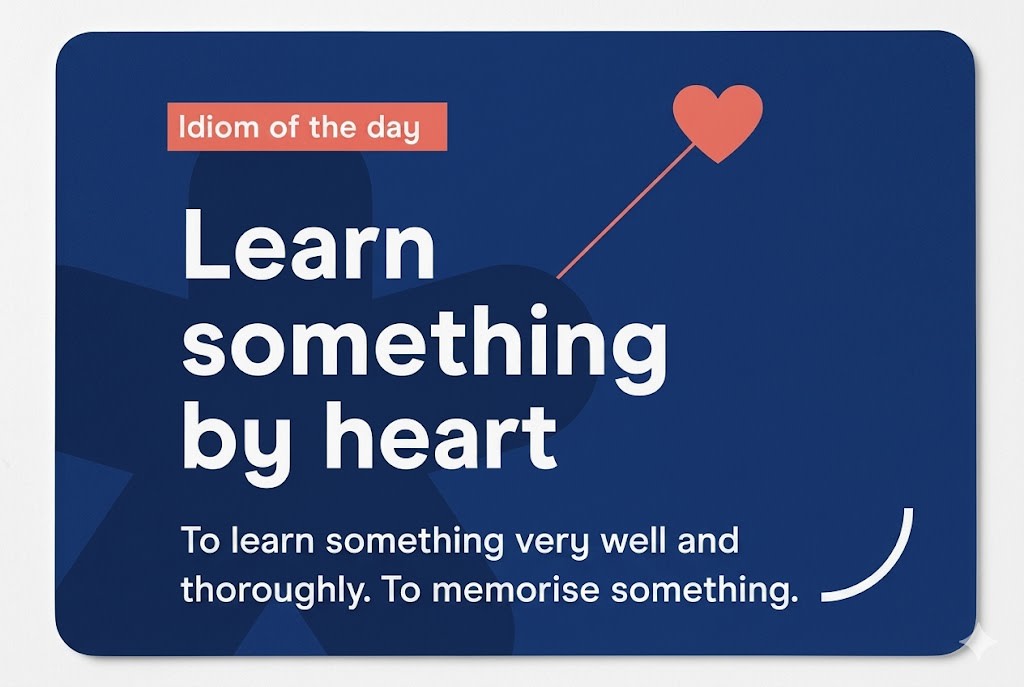
Learn by heart /lɜːn threeɪ hɑːt/ có nghiàà memorize something so carefully that it can be repeated accurately without looking at the document.
This is an idiom that is often used when talking about memorizing a poem, passage, speech, or important piece of knowledge. In Vietnamese, learn by heart can be understood as memorization.
For example:
I had to learn by heart a short poem for my English class.
Many students try to learn model answers by heart before the IELTS Speaking test.
2. Origin of the idiom Learn by heart
The interesting point of the idiom Learn by heart lies in the word heart. Why is memorization associated with the heart, instead of the brain?
This expression is rooted in the ancient Greek notion that the heart is not only the organ that creates life, but also the center of all emotions, thoughts, souls, and especially memory. In Old English, the word heart not only means heart in an anatomical sense, but is also used to refer to spirit, will, courage, mind, and intellect.
Over time, this concept gradually entered European language and culture, especially through the French phrase apprendre par cœur, meaning "learning by heart". This expression is said to have influenced English, creating the phrase learn by heart to refer to memorizing something carefully.
Today, although modern science has proven that it is the brain that processes and stores memories, the phrase learn by heart is still commonly used in everyday English. When saying learn something by heart, native speakers do not take it literally, but understand that it is memorized so well that it can be repeated without looking at the document.
3. How to use idiom Learn by heart in sentences
3.1. Common Structure: Learn something by heart
This is the most general and common structure. In particular, "something" is a noun or noun phrase that refers to a thing/thing that you need to remember.
S + learn + something + by heart
something: nouns/noun phrases
The phrase "by heart" serves as an adverb for a way, always behind the object
of the verb "learn".
For example:
She learned the entire vocabulary list by heart to prepare for the IELTS exam.
When I was in high school, I often learned historical facts by heart, but now I prefer understanding the reasons behind them.
3.2. Common Collocations with Learn by Heart
Learn by heart often comes with specific nouns related to learning, art, or academics. Here are common phrases you can adopt:
Phrases | Vietnamese Meaning |
learn a poem by heart | memorize a poem |
learn a speech by heart | memorize a speech |
Learn a formula by heart | memorize a recipe |
Learn A Song by Heart | memorize a song |
Learn a script by heart | memorize the script |
Learn Vocabulary by Heart | memorize vocabulary |
Learn Lines by Heart | memorize lines |
For example:
Actors usually learn their lines by heart before rehearsals.
In my opinion, learning formulas by heart can be useful, but students also need to understand how to apply them.
3.3. Commonly used tenses with learn by heart
The idiom learn by heart can be used in many different tenses, depending on the time and meaning you want to express it. Here are the common tenses with this verb:
Past Simple: Used when talking about a past learning experience or about a time when you had to learn or remember something. (Suitable for IELTS Speaking Part 1 & Part 2).
For example, I learned many English phrases by heart when I prepared for my exam.
Present Perfect tense: Used when you want to say that you've memorized it and still remember or can use it.
For example, I have learned the speech by heart, so I feel more confident now.
Future Simple: Used when you want to say that you will memorize something in the future.
For example, I will learn this presentation by heart before tomorrow's class.
Missing verbs (should, need to, have to): In IELTS Academic Writing or Speaking, learn by heart can also be accompanied by missing verbs to express advice, obligations, or opinions.
For example, candidates need to learn useful expressions by heart, but they should also practise using them naturally.
4. Differentiate between Learn by heart, Memorize, and Learn by rote structures
When talking about "memorizing" in English, many of you often use learn by heart, memorize and learn by rote interchangeably. However, these three clusters are not exactly the same. The difference lies in the nuances of meaning, the level of naturalness, and the context in which you use it.
4.1. Overview comparison table: Learn by heart, Memorize and Learn by rote
Structure | Context of use | Commonly used with |
Memorize | Only the act of remembering, memorizing, or saving a piece of information in memory. | poems, speeches, recipes |
Learn by heart | Memorizing and remembering each word accurately and in detail without looking at the document. | vocabulary, formula, phone number, password, first name, or an important piece of information. |
Learn by rote | Memorization by repetition continuously but without understanding the content, rote learning. | Rules, answers, facts, information |
4.2. Detailed analysis of each structure
What does Learn by heart mean?
Learn by heart is memorizing something to the point where it can be rephrased or rewritten accurately without looking at the document. This idiom has a neutral meaning, often used for content such as poems, speeches, recipes, dialogues, paragraphs, or songs.
S + learn + something + by heart
For example:
I learned the poem by heart for my English class.
Many students try to learn IELTS model answers by heart.
What does Memorize mean?
Memorize is a verb that means to remember, memorize, or save a piece of information in memory. Compared to learn by heart, the word memorize has a wider range of uses and can be used in many different contexts. Memorize usually applies to vocabulary, formulas, phone numbers, passwords, historical events, proper names, or an important piece of information.
For example:
I need to memorize 20 new words every day.
Students often memorize formulas before a math exam.
What does Learn by rote mean?
Learn by rote means rote learning, that is, learning by repeating many times to remember mechanically, but not really understanding the content in depth. This is a cluster that is often more negative than learn by heart and memorize.
For example:
Some students learn grammar rules by rote without knowing how to use them.
He learned the answers by rote, so he struggled when the examiner asked a different question.
5. Phrases/idioms synonymous with Learn by heart in English
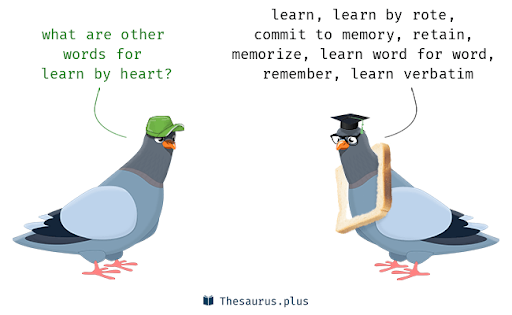
To diversify your vocabulary and avoid repetition errors in the IELTS test, you can replace learn by heart with a variety of words or phrases such as:
Phrases/Idioms | Meaning | Example |
Commit something to memory | Remembering something intentionally, deliberately remembering | He committed the entire speech to memory. |
Engrave/Etch something on someone's memory | Engraving Something in the Mind/Memory | The strict but valuable lessons from my high school teacher were permanently engraved on my memory. |
Have/Get something down pat | Grasp information very well, memorize it very well or practice to the point of proficiency | I practised my presentation many times until I got it down pat. |
Know something backwards / Know something backwards and forwards | Memorize something to the point where you can read it aloud. | He loves history so much that he knows all the major historical dates backwards |
Know something by heart | Emphasis on status and results after memorization | I know this song by heart because I have listened to it hundreds of times. |
Recite from memory | Re-read or re-present from memory, without looking at the document | The students had to recite a poem from memory. |
Remember something word for word | Remember every word accurately | She remembered the teacher's explanation word for word. |
6. Applying the Learn by heart structure in the IELTS test
In IELTS Speaking, learn by heart can be used when you talk about how you study at school, how to study for an exam, how to memorize vocabulary, or the experience of learning something. This cluster is particularly suitable for topics such as Education, Memory, Exams, School life, and Learning methods.
Application in IELTS Speaking Part 1
In IELTS Speaking, learn by heart can be used when you talk about how you study at school, how to study for an exam, how to memorize vocabulary, or the experience of learning something. This cluster is particularly suitable for topics such as Education, Memory, Exams, School life, and Learning methods.
Question: How do you usually prepare for exams?
Answer: I usually review my notes and learn key formulas by heart, especially before science or math exams. However, I also try to understand how to apply them.
Application in IELTS Speaking Part 2 (Cue Card)
In Part 2, you can use learn by heart when talking about a learning experience, a presentation, an exam, or a time you had to memorize something.
Cue Card:
Describe a time when you had to learn something difficult
Answer:
One time I had to learn something difficult was when I prepared for a school presentation. I had to explain a science topic in front of my classmates, so I decided to learn the main points by heart. At first, I tried to memorize the whole script, but then I realized that it made me sound like a robot. After that, I only
learned the key ideas by heart
and practised explaining them in my own words. This helped me feel more confident and speak more naturally.
Application in IELTS Speaking Part 3 (Problem Discussion)
Part 3 usually asks you to give a deeper perspective on education, memory, or learning methods. This is a great part to use learn by heart with synonyms such as memorize, learn by rote, understand concepts or apply knowledge.
Cue Card: Is rote learning common in your country?
Answer: Yes, in some schools, students still learn a lot of information by heart
, especially before exams. This method can help them remember facts quickly, but it may not improve critical thinking or problem-solving skills.
Applications in IELTS Writing Task 2
In IELTS Writing Task 2, learn by heart can be used when you write about education, study methods, exams or the role of memory in learning. However, since this is an academic article, you should use this phrase selectively and combine it with more formal expressions such as memories key information, understand underlying concepts, apply knowledge in practice.
Reference topic: Some people believe that students should memorise facts, while others think they should focus more on understanding concepts. Discuss both views and give your opinion.
Sample Passage:
On the one hand, learning certain information by heart can be beneficial, especially in subjects that require accuracy. For instance, students often need to memorise mathematical formulas, scientific terms or historical dates before they can use them effectively. However, relying too much on memorisation may encourage passive learning. If students only learn facts by heart without understanding the underlying concepts, they may struggle to apply their knowledge in unfamiliar situations. Therefore, while memorisation has its place in education, it should be combined with critical thinking and practical application.
→ This passage uses learn by heart in a natural and academic way. The phrase is not overused, and is combined with ideas such as understanding concepts, applying knowledge and critical thinking, helping the article to be more in-depth.
7. Idiom Learn by heart application exercise (with answers)
Exercise 1: Fill in the blank with the correct form of the learn by heart phrase.
1. I have to .................. this poem .................. for tomorrow's English class.
2. She .................. her speech .................. before the presentation.
3. Many students try to ..................... IELTS model answers .................., but this is not always effective.
4. When I was younger, I often .................. Multiplication tables ...................
5. He is .................. his lines .................. for the school play.
6. You don't need to .................. every sentence ..................; just understand the main ideas.
7. They .................. The Song .................. and performed it confidently.
8. I'm trying to .................. some useful phrases .................. for my IELTS Speaking test.
9. Our teacher asked us to .................. The Short Dialogue ...................
10. She had .................. the whole script .................. before the rehearsal.
Exercise 2: Each of the following sentences contains errors related to how to use learn by heart. Let's correct it.
1. I learned by heart the speech last night.
2. She learns the poem by hearts.
3. We should not learn answers by heart for IELTS.
4. He learns his lines by heart before the play.
5. I memorized the essay by heart.
6. They learned by heart all the formulas.
7. Students should learn every IELTS essay by heart to get a high score.
8. I am learn this song by heart.
9. She has learned the dialogue by heart.
10. My teacher asked us learning the paragraph by heart.
Answer:
Exercise 1: Fill in the blank with the correct form of the learn by heart phrase.
1. Learn / By Heart 2. Learned / By Heart 3. Learn / By Heart 4. Learned / By Heart 5. learning / by heart | 6. Learn / By Heart 7. Learned / By Heart 8. Learn / By Heart 9. Learn / By Heart 10. Learned / By Heart |
Exercise 2: Each of the following sentences contains errors related to how to use learn by heart. Let's correct it.
1. I learned the speech by heart last night.
2. She learns the poem by heart.
3. We should not learn answers by heart for IELTS.
4. He learns his lines by heart before the play.
5. I memorized the essay. / I learned the essay by heart.
6. They learned all the formulas by heart.
7. Students should not learn every IELTS essay by heart to get a high score.
8. I am learning this song by heart.
9. he has learned the dialogue by heart.
10. My teacher asked us to learn the paragraph by heart.
Understand how to use Learn by heart in English
Learn by heart is a familiar idiom in English, meaning to memorize or memorize a content so thoroughly that it can be repeated accurately without looking at the document. When used correctly, learn by heart not only helps you express your learning methods more accurately, but is also a useful phrase to apply in familiar IELTS topics such as Education, Exams, Memory and Learning methods.
If you are preparing to take the IELTS test in the near future, IDP can be a reliable companion from the time you learn information, practice until you enter the official test day. As one of the co-owners of the IELTS test, IDP provides a professional, transparent and convenient test experience for candidates.
You can refer to IDP's support services such as:
Experience the IELTS practice test to familiarize yourself with the question structure, time pressure, and current competency assessment.
Easily find the right IELTS test location nationwide
Learn about the computer-delivered IELTS test with fast results that suit your needs.
Stay up to date with the latest information on IELTS test fees, test schedules and regulations to know before the test date.
Check out the test schedule and register for your IELTS test with IDP today!