


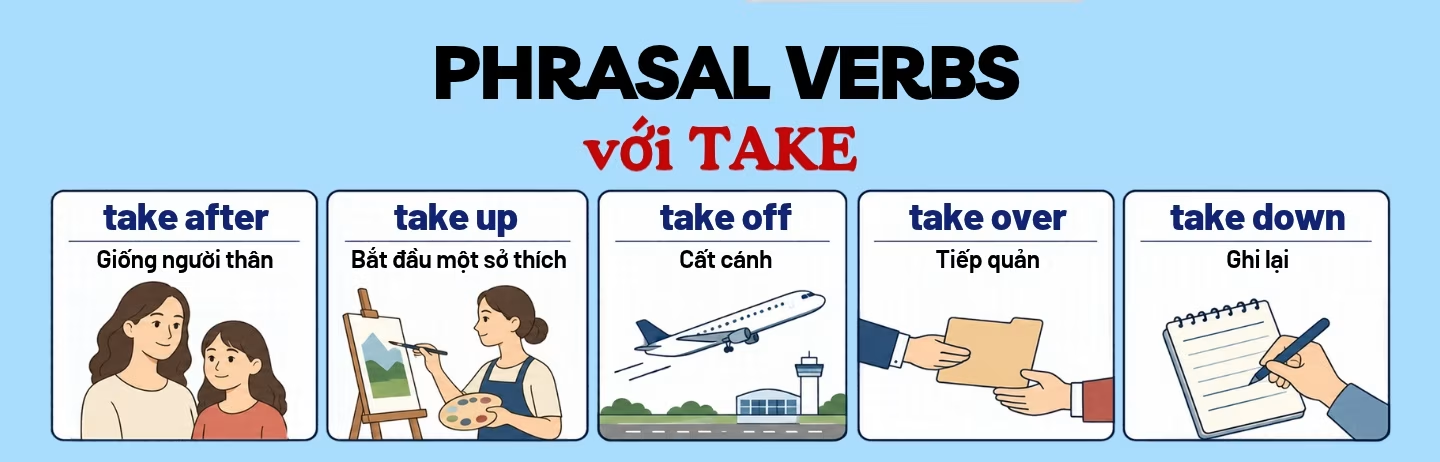
Phrasal verbs—verb plus adverb or preposition—are essential in everyday English communication and are highly valued in the IELTS exam. This article introduces topic-based phrasal verbs to help you sound fluent, more like a native speaker. Let’s explore!
1. What Is a Phrasal Verb?
A phrasal verb is a short phrase acting like a verb, combining a main verb with an adverb or preposition. The meaning often changes significantly compared to the base verb.
Example: I came across them in a blog post.
Here, “come” by itself means to move forward. When combined with “across,” the phrasal verb means to discover something by chance.
2. Why Learn Phrasal Verbs by Topic?
Benefits:
Easier to remember: Grouping related phrasal verbs helps link meanings.
More effective learning: Understanding different contexts helps you apply them correctly.
Saves time: You learn multiple useful expressions in a single theme instead of random lists.
3. Common IELTS-Themed Phrasal Verbs
Education
Phrasal Verb | Meaning | Example |
|---|---|---|
fall behind | lag behind classmates | He was ill and fell behind in schoolwork. |
catch up | make up missed lessons | I am catching up on last week’s assignments. |
go over | review notes | I always go over my notes before exams. |
drop out | leave school early | Teenagers who drop out struggle to find jobs. |
hand in / turn in | submit work | I handed in my homework late again. |
Family & Friends
Phrasal Verb | Meaning | Example |
|---|---|---|
get along | have a good relationship | You two seem to get along well. |
grow apart | drift apart | He and his wife grew apart over time. |
get together | gather socially | We get together with relatives every weekend. |
lose touch | lose contact | I lost touch with Peter for five years. |
Environment
Phrasal Verb | Meaning | Example |
|---|---|---|
clean up | tidy or clean | The community cleaned up the park. |
cut down | reduce or fell trees | They cut down many trees near the road. |
use up | consume entirely | Don’t use up all the milk. |
die out | become extinct | Many species may die out soon. |
Travel & Holidays
Phrasal Verb | Meaning | Example |
|---|---|---|
pick someone up | collect someone by car | Can you pick me up at the station? |
check in | register at hotel/airport | We checked in at 3 pm. |
take off | aircraft departure | The plane will take off soon. |
speed up | go faster | He needs to speed up or we’ll be late. |
Feelings & Emotions
Phrasal Verb | Meaning | Example |
|---|---|---|
cheer up | become happier | I cheered her up with some funny stories. |
break down | become upset or cry | She broke down hearing the sad news. |
bottle up | suppress emotions | He bottled up his feelings for years. |
Food & Cooking
Phrasal Verb | Meaning | Example |
|---|---|---|
boil down | reduce liquid by boiling | She boiled down the sauce to make it richer. |
whip up | prepare quickly | I can whip up an omelet in minutes. |
gobble down | eat quickly | He gobbled down a sandwich. |
Work & Career
Phrasal Verb | Meaning | Example |
|---|---|---|
carry out | perform or complete | They carried out the experiment successfully. |
take over | assume control | The big company will take over the small one. |
slack off | do less work | He has been slacking off at work lately. |
pile up | accumulate tasks | Work piles up at year-end deadlines. |
Free Time & Hobbies
Phrasal Verb | Meaning | Example |
|---|---|---|
take up | start a hobby | She took up painting last year. |
give up | quit a hobby | He gave up tennis after the injury. |
hang out | spend time socially | We hang out with friends every Friday. |
Decision & Planning
Phrasal Verb | Meaning | Example |
|---|---|---|
sleep on it | wait before deciding | I need time to sleep on it and decide tomorrow. |
weigh up | consider pros and cons | We weighed up options before choosing. |
come up with | propose a solution | She came up with a brilliant marketing idea. |
These phrasal verbs can significantly boost your lexical resources and fluency in your IELTS Speaking and Writing.
Prepare effectively with IDP: Gain access to expert tips, sample answers, workshops, and online courses to help you achieve your target band score.
Ready to get started? Register for IELTS with IDP today!
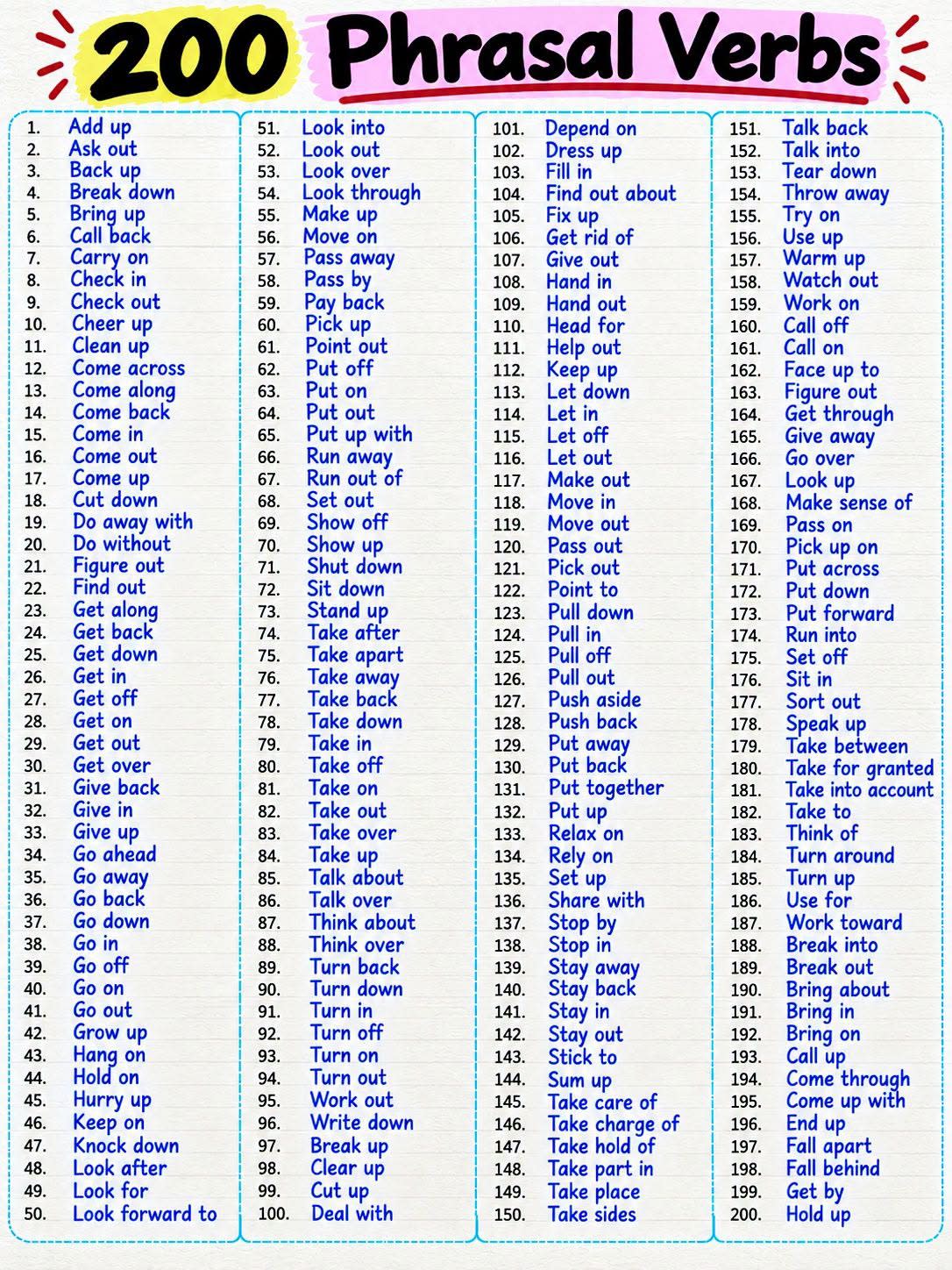
4. List of 200+ common phrasal verbs by topic
To use phrasal verbs more naturally and accurately, you should learn by topic rather than memorizing individual phrases. The list below includes distinct phrases, broken down into common topics in the IELTS test.
Phrasal verb | Meaning | Example |
|---|---|---|
Go Over | review, review | I go over my notes before each test. |
hand in | Submission of papers, documents | Please hand in your essay by Friday. |
hand out | Distribution, distribution | The teacher handed out the worksheets. |
look up | Lookup | I looked up three unfamiliar words. |
read up on | Read on to find out more | She read up on the topic before class. |
catch up on | to make up for the shortfall | I need to catch up on my reading. |
Keep up with | Keeping Up | He finds it hard to keep up with the class. |
fall behind | lagging behind, behind schedule | I fell behind after missing two lessons. |
drop out of | abandoning courses and programs | She dropped out of the course. |
sign up for | Register to participate | I signed up for a writing workshop. |
work on | devote efforts to improve and implement | I'm working on my pronunciation. |
figure out | understand, figure out how to solve | We figured out how to solve the problem. |
write down | Record | Write down the key points. |
read through | read it all to check and grasp the content | Read through your answer before submitting it. |
Sum Up | Summary | Can you sum up the main argument? |
brush up on | Review what you've learned | I'm brushing up on English grammar. |
Think Through | Think carefully | Think through your answer before speaking. |
Cross Out | Strike out | Cross out the incorrect word. |
Get Through | Get a fair amount of work done | She got through the reading before class. |
run through | rehearsal and review | We ran through our presentation twice. |
Pore Over | Study carefully, ponder | The scholar pored over ancient manuscripts for hours. |
miss out on | Missed | Do not miss out on the revision session. |
carry out | implementing and conducting | Our team carried out a survey. |
take on | Receiving Jobs and Responsibilities | She took on a new role. |
take over | Takeover | Minh took over the project in April. |
set up | Establishment, Establishment | They set up a small design studio. |
draw up | Drafting | We drew up a detailed schedule. |
follow up on | continue to process and learn | I'll follow up on your request tomorrow. |
Take off | layoffs due to personnel cuts | The company laid off several workers. |
step down | resignation, resignation | She stepped down as team leader. |
fill in for | Temporary replacement | Can you fill in for me on Monday? |
deal with | Handle | We need to deal with this complaint. |
sort out | settling and arranging satisfactorily | Let's sort out the timetable. |
bring in | inviting and bringing people to support | They brought in a trainer for the workshop. |
Call off | Cancel | They called off the meeting. |
put forward | Recommendations | He put forward a practical solution. |
Take Up | occupy time and space | Emails take up an hour of my day. |
Go Through | Closer Examination | We went through the application forms. |
Report back | Report back | Please report back after the interview. |
Team Up | Collaboration | We teamed up with another group. |
wrap up | Finished, Finished | Let's wrap up the discussion. |
clock in | Attendance at the start of work | Staff clock in before their shifts. |
cut down | Cutting, cutting | They cut down the damaged tree. |
cut back on | Cut down on usage | Our class is cutting back on plastic packaging. |
use up | used up | We used up all the water in the tank. |
run out of | Out of Supply | The village ran out of clean water. |
Throw away | Disposal | Don't throw away reusable containers. |
clean up | Cleanup | Volunteers cleaned up the riverbank. |
die out | extinct, gradually disappearing | The species could die out. |
Dry Up | Dry | The stream dried up during the drought. |
wipe out | destruction and erasure | The fire wiped out a large area of forest. |
Break Down | Decomposition | These materials break down naturally. |
Phase Out | Phased removal | The school plans to phase out single-use cups. |
Build up | accumulation | Plastic waste built up along the river. |
give off | radiate, discharge | The old engine gives off thick smoke. |
Heat up | Warming up | The greenhouse heats up in the sun. |
cool down | Cool down, reduce heat | The air cooled down after sunset. |
put out | Quenching | Firefighters put out the forest fire. |
wash away | washed away | Heavy rain washed away the topsoil. |
soak up | permeate, absorb liquids | The dry soil soaked up the rain. |
clear up | Become clear | The weather cleared up in the afternoon. |
blow over | passing, often talking about the storm | We waited for the storm to blow over. |
Log in | Log in | Log in to view your results. |
log out | Log out | Remember to log out after class. |
sign in | Log in, confirm access | Sign in with your school email. |
sign out | Log out | I signed out of my account. |
Turn on | Turn on the device | Turn on the projector, please. |
Turn off | Turning off the device | She turned off the microphone. |
back up | Backups | I back up my files every week. |
plug in | Plugged in, connected by plug | Plug the charger in before the lesson. |
scroll down | Scroll down | Scroll down to see the final question. |
scroll up | Scroll up | Scroll up to read the instructions again. |
Zoom in | Enlarge | Zoom in to read the small text. |
Zoom Out | Shrinkage | Zoom out to view the whole map. |
shut down | Shut down, stop operation | The system shut down unexpectedly. |
Start up | Startup | My computer starts up quickly. |
pop up | Sudden appearance | A reminder popped up on the screen. |
type up | Retyping into text | I typed up my handwritten notes. |
Downtime, crash | The website went down during registration. | |
opt out | Opt-out, opt-out | You can opt out of email notifications. |
filter out | Filter out | The app filters out unwanted messages. |
print out | Print to paper | Please print out the worksheet. |
work out | Exercise | I work out at the gym twice a week. |
warm up | Warm-up before exercise | She warmed up before the race. |
cool off | cools down, cools the body | We sat in the shade to cool off. |
give up | giving up a habit | I gave up drinking fizzy drinks last year. |
cut out | removed from the diet and daily life | He cut out sugary snacks. |
Come down with | onset of the disease | I came down with a cold on Monday. |
get over | recovery from illness | She is getting over the flu. |
pass out | fainting | He passed out and needed medical help. |
throw up | vomiting | She felt dizzy and threw up. |
Fight off | Resistance to disease or attack | He is trying to fight off a cold. |
Shake off | get rid of symptoms, conditions | I can't shake off this cough. |
pull through | overcoming a disease or critical condition | The patient pulled through after surgery. |
lie down | lying down | I lay down for a short rest. |
sit up | sit up | She sat up in bed. |
slow down | Speed Reduction | He slowed down near the end of the run. |
Wear Off | gradually decreases and then wears off | The effect of the anaesthetic wore off. |
Flare up | flare-up or relapse | Her knee pain flared up again. |
bring on | causing symptoms and conditions | She said stress brought on her headaches. |
swell up | Swelling | His ankle swelled up after the fall. |
check on | Check the status of AI | The nurse checked on the patient. |
Wake Up | wake up | I woke up before my alarm. |
get up | Get out of bed | I got up ten minutes later. |
sleep in | waking up later than usual | We usually sleep in on Sundays. |
put on | Wear, Wear | Put on a jacket before going outside. |
Take off | removal, removal | Please take off your shoes. |
put away | stored in the prescribed place | I put the dishes away after dinner. |
tidy up | tidy up | We tidied up the living room. |
wash up | Washing dishes, commonly used in the UK | I'll wash up after lunch. |
Eat Out | Eat at a restaurant, outside the house | We eat out once a week. |
Eat Up | Eat it all | The children ate up their lunch. |
Boil Over | Boiling | The milk boiled over. |
Flash Up | Chop and chop into small pieces | Snap up the onions. |
cut up | Cut into portions | She cut up the fruit for breakfast. |
Take Out | Bring Out | Can you take out the rubbish? |
Hang Up | Hanging Up | Hang up your coat near the door. |
Fold up | Folding | She folded up the blanket. |
dress up | formal and sophisticated dress | We dressed up for the celebration. |
stock up on | buy and store for later use | We stocked up on rice before the holidays. |
Volume | fastening, fastening, zippering | He did up the buttons on his shirt. |
Lock Up | lock the door, lock the entire residence | Please lock up before leaving. |
Grow up | Growing up, mature | I grew up in a small town. |
Bring up | Parenting | Her grandparents brought her up. |
take after | Like a relative | He takes after his father. |
look after | Care | I look after my younger sister after school. |
get on with | get along with | I get on well with my cousins. |
fall out with | discord with | She fell out with a friend over a misunderstanding. |
make up | Reconciliation | They made up after the argument. |
Break Up | Breakup | The couple broke up last winter. |
look up to | Respect and admiration | I look up to my older brother. |
put up with | Endurance | She won't put up with rude behaviour. |
cheer up | cheer up, make someone happier | The visit cheered him up. |
Calm Down | Calm down | We waited for everyone to calm down. |
open up | openly sharing feelings | He opened up about his worries. |
Let Down | disappointed | I don't want to let my teammates down. |
Hang Out | Spend time relaxing with whom | We hang out after class. |
Get Together | Meetings and gatherings | Our family gets together every month. |
reach out to | proactive contact | I reached out to an old friend. |
Stand by | support, be on your side | My friends stood by me during a difficult time. |
look forward to | eagerly anticipating | I'm looking forward to seeing my family. |
bring along | Who to take with you | I brought my sister along to the gathering. |
set off | Departure | We set off before sunrise. |
get on buses, trains, planes... | We got on the bus near the museum. | |
get off | get off the bus, train... | Get off at the next stop. |
Check in | check-in, flight | We checked in at the hotel. |
check out | Check out | We checked out before noon. |
Pick Up | Who to pick up by vehicle | My cousin picked me up at the station. |
drop off | Bring Whoever Comes and Let Them Down | The driver dropped us off outside the hotel. |
see off | Who to see off on departure | My parents came to see me off. |
get away | Going on vacation for a while | We're hoping to get away for a weekend. |
head back | Start Returning | We headed back to the hostel before dark. |
Come back | Back | She came back from her trip yesterday. |
go back | Back to one place | I went back to the station for my bag. |
Stop Over | Stopping in the middle of the journey | We stopped over for one night. |
pull over | pull over | The driver pulled over to check the map. |
hold up | slowing down, delaying | The storm held up our flight. |
Turn back | Turn around, back | We turned back because the road was closed. |
run into | Accidentally encountered | I ran into a classmate at the airport. |
come along | Accompanying | You can come along on the trip. |
Run Away | Run away, walk away | Their dog ran away during the trip. |
look out for | Pay attention to recognize | Look out for the sign to the campsite. |
save up | Gradually saving for a goal | I'm saving up for a laptop. |
pay back | Return the borrowed money | I paid my friend back yesterday. |
Pay Off | Pay off the debt | She paid off her student loan. |
cut down on | reduce consumption and spending | I'm cutting down on unnecessary purchases. |
Get by | Managing to make ends meet | He gets by on a modest budget. |
live on | living on a source of money | She lives on her scholarship and savings. |
tremble up | incurring large costs | He ran up a large bill on holiday. |
Sell Out | Sold Out | The shop sold out of notebooks. |
shop around | Compare prices, choose before buying | We shopped around for a better deal. |
Rip off | cutting and slashing, deceiving for money | The seller ripped me off. |
put aside | Save | I put aside a little money each month. |
set back | cost anyone a sum of money | The repair set me back fifty dollars. |
Print Chip | donate money | We all chipped in for the present. |
cash in on | Take advantage of opportunities to make a profit | Some shops cashed in on the new trend. |
take back | Return Goods | I took the damaged bag back to the shop. |
splash out on | Spend a lot of money on something special | She splashed out on concert tickets. |
fork out | spend money, often don't want to spend | I had to fork out for a new charger. |
add up | Adding up | Add up the prices before paying. |
knock off | Reduce an amount from the price | They knocked ten dollars off the price. |
put down | Prepaid, Deposit | We put down a deposit on the flat. |
Come up with | Come up and propose | We came up with a backup plan. |
Point Out | indicated | The teacher pointed out two errors. |
speak up | Speak Louder | Please speak up so everyone can hear. |
Talk Over | Discuss carefully | Let's talk the options over after class. |
bring about | create, resulting in | The feedback brought about several changes. |
bring back | Recall | That photo brought back happy memories. |
Bring Out | issuance, publication | The publisher brought out a new workbook. |
Come Out | Issued and announced | The report came out on Monday. |
Come across | Accidentally found | I came across an interesting article online. |
look into | review and investigation | They are looking into the complaint. |
Go On | continue, stretch | The discussion went on for another hour. |
Go ahead | takes place, is conducted | The event will go ahead as planned. |
Go Off | squeaking, shouting | A phone alarm went off during the talk. |
put off | Postponement | We put off the trip until Friday. |
Turn Down | Disclaimer | She turned down the invitation. |
Turn Up | appearance, arrival | More people turned up than expected. |
find out | Find, Know | I found out when the course starts. |
rule out | Exclusions | We ruled out the most expensive option. |
run over | lasting beyond the expected hours | The meeting ran over fifteen minutes. |
end up | Finally in the situation, what to do | We ended up choosing the online course. |
5. How to learn phrasal verbs effectively
5.1. Learn the whole group, not learn each word individually
When learning phrasal verbs, don't just write a pair of meanings such as put off = delay. This way of learning helps you remember the meaning, but it does not indicate which component the phrase goes with, whether it needs a new word, and where the new word should be placed.
Instead, write down the complete usage pattern of the phrasal verb:
How to write too short | More useful ways to record |
put off = delay | put something off / put off doing something |
look forward to = expect | look forward to + noun/V-ing |
run out of = run out | run out of something |
bring up = mention | Bring something up, such as bring up a problem |
This way of writing helps you learn the meaning + structure + position of the new language at the same time, so it is easier to use correctly when speaking or writing.
When reviewing, don't just read the meaning and then move on to the next word. Cover the example sentence and try to come up with a new sentence with that phrasal verb. If you recognize the meaning but still don't know how to phrase it, it means that the structure still needs more practice.
5.2. Learning by grouping root verbs and minor verbs
An effective way to learn phrasal verbs is to collect phrases with the same root verb and place them next to each other. This is especially useful for easily misunderstood phrases such as take up, take on, and take over, as you can clearly see the difference in meaning and context in which it is used.
Instead of learning a long list, start with a few clusters and tie each cluster to a specific situation:
Scenario | Matching Cluster | Self-Titled Sentences |
Start a hobby | Take Up | I'd like to take up photography. |
Get more responsibility | take on | I can take on one more task. |
Taking over the work | take over | Mai will take over the project. |
Once you understand the meaning, change the subject, time, new word, or context in the sentence. For example, the word Mai will take over the project, you can change it to I took over the team last month. This practice forces you to actually use phrasal verbs, rather than just recognizing the meaning when you see it.
You can also learn by particles such as up, down, out, off, on. Some subtexts often evoke certain meanings:
Words | Common semantic tendencies | Example |
up | increased, completed, switched to a new state | grow up, use up, set up |
down | drop, decommission, split | slow down, break down |
out | out, out, detect | go out, run out, find out |
off | leave, stop, detach | Take Off, Call Off |
on | Continue, Turn On, Put On | carry on, turn on, put on |
However, this is just a tendency to help you guess the meaning, not a rule that applies to every phrasal verb. When you encounter a new phrase, you should still check the meaning and usage in the specific context.
5.3. Learning according to practical topics
When practicing IELTS Speaking, instead of learning discrete phrasal verbs, choose a familiar topic and attach a few appropriate phrases to the experience or idea you can actually say.
This method helps you remember phrasal verbs along with the use case, so when you encounter a similar topic in the test, it will be easier to recall the words. However, don't try to cram too many phrases into one answer. Choose phrasal verbs that really match what you want to express, and then double-check the meaning and structure before using them.
5.4. Memorization through context and images
For example, with pick up, you can create a separate image for each meaning:
pick up → picture of a hand picking up a pen;
picking up anyone → the picture of a car stopping to pick up passengers;
Natural reception → a person learning a language through daily communication.
The important point is that each meaning should have its own context or image. If a phrasal verb has multiple meanings but you associate it with only a single image, it's easy to remember one meaning and miss the rest.
You can also combine the image with a short sentence. For example, instead of just remembering to pick up = pick up, write: I'll pick you up at the airport.
When meanings, images, and example sentences are linked together, phrasal verbs are easier to remember and also easier to use in context.
5.5. Applying the Spaced Repetition technique
Spaced repetition is a way of reviewing vocabulary at gradual intervals, rather than repeating it over and over again in the same session. With phrasal verbs, this method is especially useful because you need to remember not only the meaning but also the structure and context in which it is used.
You can start with a simple calendar:
Review times | Suggested timing | Operation |
1 | After school | Read example sentences |
2 | After 1 day | Remember the meaning of not looking at the answer |
3 | After 3 days | Fill in phrases in sentences |
4 | After 7 days | Ask yourself |
5 | After 14 days | Mixed with easily mistaken clusters |
6 | After 30 days | Write short paragraphs |
The important point is not to just re-read. Every time you revise there should be an activity that forces you to memorize or use phrasal verbs yourself, such as filling in the blanks, making sentences, or speaking aloud.
The above calendar is just a suggestion. For phrases you often forget, review it sooner. On the other hand, if you can use a correct and natural phrasal verb in your sentences, you can extend the gap between reviews.
6. Phrasal Verb exercises with detailed answers
Exercise 1: Fill in the appropriate urinary words in each blank.
1. Please write .................... the new vocabulary in your notebook.
2. The plane took .................... thirty minutes late.
3. I need to brush .................... on my English before the interview.
4. We have run .................... of printer paper.
5. She was brought .................... by her grandparents.
6. Please turn .................... the lights before leaving.
7. He gave .................... smoking last year.
8. I came .................... an old photograph in the drawer.
9. Students must hand .................... their assignments by Friday.
10. The meeting has been put .................... until next week.
Exercise 2: Rewrite the following sentences using the Phrasal Verb suggested in parentheses
1. They postponed the meeting until Monday. (PUT)
→ They ................................................................................................
2. Please extinguish the candles before leaving. (PUT) → Please ..............................................................................................
3. I accidentally found an interesting podcast. (COME) → I ....................................................................................................
4. She resembles her older sister. (TAKE) → She .................................................................................................
5. The researchers conducted three experiments. (CARRY) → The researchers ................................................................................
6. He stopped smoking two years ago. (GIVE) → .................................................................................................
7. Please investigate the customer's complaint. (LOOK) → Please ................................................................................................
8. We have no coffee left. (RUN) → We .................................................................................................
9. The director rejected the proposal. (TURN) → The director .........................................................................................
10. Can you collect me from the station? (PICK) → Can you ...........................................................................................?
Answer:
Exercise 1: Fill in the appropriate urinary words in each blank.
Sentence | Answer | Explanation |
1 | down | Write down: write or write down |
2 | off | Take Off: Take Off |
3 | up | Brush Up On: Review Knowledge |
4 | out | Run Out Of: Run Out of Something |
5 | up | Bring Up: Nurture |
6 | off | Turn Off: Turn off the device |
7 | up | Give up |
8 | across | Come Across: Accidentally Found |
9 | in | Hand Print: Submission |
10 | off | Put Off: Delay |
Exercise 2: Rewrite the following sentences using the Phrasal Verb suggested in parentheses
1. They put the meeting off until Monday.
2. Please put the candles out before leaving.
3. I came across an interesting podcast.
4. She takes after her older sister.
5. The researchers carried out three experiments.
6. He gave up smoking two years ago.
7. Please look into the customer's complaint.
8. We have run out of coffee.
9. The director turned down the proposal.
10. Can you pick me up from the station?
Apply Phrasal Verb in context with IDP
Learning phrasal verbs effectively requires a combination of three elements: understanding the meaning in context, grasping the structure, and using it yourself. Therefore, the list of 200 phrasal verbs suggested above is a reference to help you choose the right phrase you need, instead of a list of words that have to be memorized at the same time.
Start with five phrases on a familiar topic, give each phrase a sentence, and then try using them in a short paragraph. As you review, check the meaning, structure, placement of the new word, and the form of the verb. Learning this way will help you remember phrasal verbs that are tied to practical usage and are easier to apply when speaking or writing.