



When you take an English language test, you want to feel confident that you’ve developed the skills you need, not just to meet university or visa requirements, but to thrive in your new life. For some people, this takes a little more time.
At IELTS, we use a transparent scoring system that clearly explains the difference between each band score, helping you focus on the areas that will make the biggest difference to your results.
In this article, we’ll look at how you can move from IELTS band 5 to 6. We’ll explore what keeps many people at band 5 and share band 6-specific study tips so you can set yourself up for success on test day and in whatever comes afterwards.
Band 5 vs Band 6: What changes?
IELTS scoring describes band 5 as a Modest User of English.
Band 6 is a Competent User of English.
So, what does this mean?
At band 5, people can handle basic communication in their own field. They can communicate and understand English in many everyday situations but are still likely to make many mistakes.
At band 6, people can communicate effectively in familiar situations and understand fairly complex English, although they still make some mistakes.
To achieve IELTS band 6, you need approximately:
IELTS Academic Reading: 23/40
IELTS General Training Reading: 30/40
IELTS Listening: 23/40
IELTS Writing and Speaking: Clear communication, organised ideas and some use of complex language
Want to know more? - Refer to the IELTS band descriptors for Writing and Speaking.
What IELTS examiners look for at Band 6
The IELTS Writing and Speaking sections are assessed by trained examiners using the official IELTS band descriptors. These criteria help ensure consistent and reliable marking standards across test centres worldwide. Understanding the IELTS band descriptors is an important part of your IELTS preparation, as they show exactly what examiners are looking for in your responses. To support your preparation, IDP offers a range of resources to help you better understand the IELTS band descriptors, so you can focus on what you need to do to increase your score.
This short 7-part video series gives a clear and simple explanation of the IELTS Writing band descriptors to help you better understand the marking criteria. It also includes sample responses, which received different band scores.
Our YouTube playlist of IELTS Speaking test samples include examiner comments and band scores.
This article breaks down the IELTS Speaking and Writing band descriptors into an easy-to-follow checklist for each marking criterion. It also includes band 6 preparation tips from IELTS experts for all four test skills.
Why many IELTS test takers stay at Band 5
If you feel like you’ve reached a plateau, you’re not alone. Many IELTS test takers find it challenging to move beyond band 5 because of these common mistakes:
Retaking the test too quickly: If you’re working towards a university admission deadline, you’ll probably want to try again as soon as you can. But if you rebook your test too soon, you’re not giving yourself time to improve your skills, so your band score probably won’t improve either. Take time to identify your weak spots and target these during your preparation.
Focusing on test strategies over language skills: Reflect on whether your English language level is sufficient to achieve a band 6. If you need to improve areas like grammar and vocabulary, doing more practice tests may not be enough. Focus on building language skills to address your specific gaps.
Not understanding the IELTS band descriptors: It’s hard to achieve a band 6 if you don’t know what that requires. If you need to improve your Writing and Speaking, study the IELTS band descriptors so you know what you need to demonstrate in your test.
Not following task instructions: It can be easy to misread instructions when you’re working with a time limit, but small mistakes can lower your score, especially in the IELTS Reading and Listening tests. Make sure you’re familiar with the different types of questions that can appear in the test and follow word limits and other instructions.
Learn more about IELTS Reading and IELTS Listening question types.
How long does it take to improve from Band 5 to Band 6?
So, how long will it take for you to get there? Here’s what our IELTS Community experts had to say:
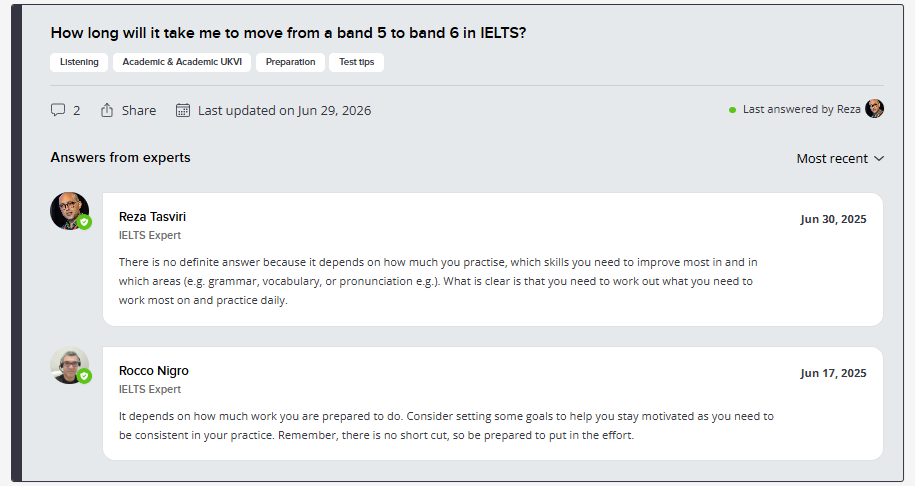
In short, the answer is different for everyone. We recommend that you start by identifying which areas you need to improve, deciding how much time you can study each day and then planning your study schedule around your test date.
Which IELTS section is holding back your score?
Before you book another IELTS test, look at which IELTS skills you need to improve.
If it’s only one, you may be able to retake just one section instead of completing a full IELTS test. For example, if you scored band 5 in IELTS Writing but you need a band 6, you may be eligible for IELTS One Skill Retake if:
You have completed a full IELTS test on computer and have received your results.
Your test was taken at an eligible test centre.
You book the retake within 60 days of your original test date.
IELTS is the only major English proficiency test to offer One Skill Retake, which allows you to retake one skill without having to repeat the whole test.
How to improve each IELTS skill to reach Band 6
Whether you’re retaking the full IELTS test or doing IELTS One Skill Retake, there are several techniques you can use during your preparation to help you achieve an IELTS band score 6 this time around.
How to get a Band 6 in IELTS Listening
Read instructions carefully: If a question asks you to Write NO MORE THAN THREE WORDS AND/OR A NUMBER for each answer, you’ll lose marks if you write four words.
Consider possible answers before listening: If you need to type a short answer or fill in a gap, think about what kind of word is missing, for example, a number, an adjective, a place, etc. When you know what you’re listening for, it’s easier to focus and rule out incorrect options.
Listen to different accents: Is there an accent you find more difficult to understand? IELTS is an international English test, so a range of accents may be used. Before your test, practise listening to different English accents such as British, Australian, New Zealand and American. Use subtitles or transcripts to build up your confidence.
Practise numbers: Numbers often come up in the IELTS Listening test, and there is sometimes more than one way to say them. For example, for “3:45pm,” a speaker might say “three forty-five" or “quarter to four.” Get familiar with the different written and spoken formats for numbers, dates, prices, times and measurements.
Work on your spelling: Do you hear the correct answer but then lose marks because you spell it wrong? Review spelling rules and common errors if this is an area you need to improve.
Build your vocabulary: The more vocabulary you know, the easier it is to understand the recordings. Speakers often use different words such as synonyms or paraphrases instead of repeating the exact words from the questions. Read our article IELTS Listening Test: Tips to Build Your Vocabulary for more guidance on what words to focus on.
How to get a Band 6 in IELTS Reading
Learn how to tackle challenging question types: Which questions did you struggle with in your last IELTS test? True/False/Not Given? Summary completion? Visit our IELTS Prepare Hub for articles that guide through each question type so you can learn strategies to improve your approach.
Manage your time: Make sure you leave enough time to read all three passages as they become more difficult as you move through the IELTS Reading test. If you ran out of time in your last test, practise reading strategies like skimming and scanning to boost your reading speed and accuracy.
Follow instructions closely: Just like in IELTS Listening, always check the word limit and the required answer format to avoid losing marks in your IELTS Reading test.
Highlight keywords: Identify keywords in the questions and options to help you find the right information in the text more quickly. It’s important to remember that you won’t always find these exact words in the texts as they might use paraphrasing, so it can be helpful to write down a few synonyms for the keywords if you have time.
Learn how to guess the meaning: If you see a word you don’t know, take a guess using context clues and move on. Read our article on how to guess the meaning of unknown words from context for tips on how to deal with this common challenge.
Read in English everyday: Develop the vocabulary and reading skills you need for a band 6 by reading variety of English-language publications, including newspapers, magazines, books, journals and reputable websites.
How to get a Band 6 in IELTS Writing
Answer every part of the question: If you want to reach a band 6 in IELTS Writing, you need to cover all the task requirements in your responses. For example, if you’re doing the IELTS Academic test, make sure you’ve included all the key features in the visual. If you’re taking the IELTS General Training test, your letter should address all the bullet points in the question prompt.
Use an appropriate tone: Do you need to write in a formal, informal or semi-formal tone? Does your language match the tone? This is especially important for the IELTS General Training test letter-writing task. Familiarise yourself with different types of letters and the appropriate language you should use for each tone.
Use paragraphs: Does your essay have an introduction paragraph, 2-3 body paragraphs and a conclusion paragraph? For IELTS Writing Task 2, you need to organise your essay into paragraphs if you want to achieve a band 6 or higher.
Stay relevant and support your ideas: At band 6, you need to link your position and main ideas to the essay question. Make sure you stay on topic, clearly explain your ideas and support these with specific examples.
Use linking devices correctly: Are you using a range of conjunctions and linking phrases to join your ideas together? Check that you know how to use linkers like in addition, for instance and despite correctly. At the same time, it’s also important not to overuse them. There’s no need to add one to every sentence.
Reduce repetition: Writing techniques like referencing and substitution can make a big difference to your score as they can help you to avoid repeating the same words throughout your responses.
Improve your grammar: As well as working on any grammar areas you struggle with, you need to use different sentence forms to reach a band 6 or higher. Examiners look for both simple and complex sentences so it’s a good idea to familiarise yourself with these sentence types.
How to get a Band 6 in IELTS Speaking
Improve your fluency: To increase your band score, you’ll need to speak for longer periods without repeating yourself or pausing too much. Use our practice IELTS Speaking questions to work on extending your answers by adding extra information or examples.
Organise your ideas: Use a variety of linking devices and discourse markers to move logically from one idea to the next (e.g. first of all, another reason for this, if you ask me etc.). However, as with IELTS Writing, be careful not to overuse these.
Paraphrase your ideas: For IELTS band 6, you need to use a range of words or expressions to explain your ideas in different ways. Focus on building vocabulary related to common IELTS topics.
Improve your grammar: Although Band 6 scorers still make grammar mistakes, their message is generally clear. To ensure you’re communicating clearly, work on the errors you make most, such as specific verb tenses, conditionals or relative clauses.
Improve your pronunciation: Do the same with the sounds and words you find the most difficult to pronounce. As with grammar, you don’t need to get everything right. But for a band 6 score, the examiner should be able to clearly understand your ideas and message.
Watch our IELTS Pronunciation Video Series.
A 4-week study plan for IELTS Band 6
There’s no one-size-fits-all approach to IELTS preparation. Some people move from band 5 to 6 quickly. But others may need more time and practice.
To help you get started, we've created a sample one-month study plan. Use it as a guide and adapt it based on what you need to improve, how you like to learn and how much study time you have.
Week | Main focus | What to do | What to use |
Week 1 | Find the areas you need to improve | ||
Week 2 | Improve your skills | ||
Week 3 | Build confidence | ||
Week 4 | Get ready for test day |
How IDP supports your IELTS preparation journey
You can find all the resources in the study plan in our IELTS Prepare Hub.
As a co-owner of the IELTS test, we offer both free and premium official preparation resources aligned with the real test. Choose from free practice tests, videos, articles, podcasts, masterclasses, online courses and more.
Find everything you need in one place to strengthen your English skills, build your confidence and achieve success both in IELTS and beyond.
FAQs