



If you’re taking IELTS for the first time, you probably have a lot of questions.
Which IELTS test should I take?
What score do I need?
How long do I need to prepare?
What preparation resources should I use?
How will I know when I’m ready?
What happens on test day?
Many test takers have the same questions when they start preparing for IELTS, which is why we’ve put together this guide.
We’ll answer each of these questions and walk you through the IELTS preparation process, so you know exactly what to expect and how to prepare with confidence.
Step 1: Understand which IELTS test you need
IELTS, or the International English Language Testing System, is the world’s leading English language test for higher education and global migration. IELTS results are trusted and accepted by over 13,500 organisations across 110 countries.
If you’re reading this article, you might need to take an IELTS test to prove your English ability to education institutions, employers, professional registration bodies or immigration authorities.
But before you start your preparation, you need to know which IELTS test to take to achieve your goals.
Choose the right IELTS test
IELTS offers two main tests, IELTS Academic and IELTS General Training. However, if you’re planning to live, work or study in the UK, you may need to take IELTS for UKVI or IELTS for UKVI Life Skills.
Here’s a breakdown of each test to help you choose the right IELTS test for your future.
IELTS test type | What it assesses | Who it is for | Common reasons for taking it |
IELTS Academic | Assesses how well you can use English in an academic environment (Listening, Reading, Writing and Speaking). | People applying to universities and other higher education institutions, as well as those seeking professional registration (for example, doctors, nurses, teachers). | Higher education study, professional registration and migration to an English-speaking country. |
IELTS General Training | Assesses how well you can use English in everyday and workplace settings (Listening, Reading, Writing and Speaking). | People planning to work, live, or migrate to an English-speaking country, or those applying for study or training below degree level. | Employment, migration, permanent residency applications, high school study, vocational education and training programs. |
IELTS for UKVI (Academic or General Training) | This is the same test as the regular IELTS Academic and IELTS General Training tests, with additional security measures that are required by UK Visas and Immigration (UKVI). | People who need to prove their English proficiency for UK visa, work, study, or migration purposes. | UK student visas, work visas and immigration applications. |
IELTS for UKVI Life Skills (A1, A2, B1) | Assesses speaking and listening skills in everyday situations. | People applying for specific UK visas, such as joining a family member in the UK or becoming a British citizen. | Family visas, visa extensions, settlement applications and British citizenship applications. |
Always check the requirements of the organisation, institution, employer or immigration authority you are applying to before booking your IELTS test.
Choose how to take the IELTS test
IELTS offers three different ways to take your test, so you can choose the option that suits your needs and helps you perform at your best.
Test format | How it works | Speaking test | Availability | Best for |
IELTS on computer | Complete the Listening, Reading and Writing sections on a computer at an official IELTS test centre. | Conducted face-to-face in a private, quiet room with an IELTS examiner. | Available for both IELTS Academic and IELTS General Training at IELTS test centres in over 100 countries. | Test takers who are comfortable typing and using a computer. |
IELTS on computer (Writing on Paper) | Complete the Listening and Reading sections on a computer but handwrite the Writing section. | Conducted face-to-face in a private, quiet room with an IELTS examiner. | Available for both IELTS Academic and IELTS General Training in selected locations. Availability varies by country, so check the booking website for local test centre options. | Test takers who prefer handwriting their IELTS Writing tasks rather than typing. |
IELTS Online | Take IELTS Academic test from home using a computer with a webcam and a stable internet connection. | Conducted one-to-one with an IELTS examiner via a live video call. | Available in more than 60 countries worldwide. | Test takers who want the convenience of taking IELTS Academic from home. Not suitable for visa or immigration purposes, which require a test taken at an official IELTS test centre. |
Note: If you’re taking IELTS for UKVI or IELTS for UKVI Life Skills, you’ll need to take your test in person at an official IELTS for UKVI test centre.
Read more:
IELTS on computer (Writing on Paper)
Find out what IELTS score you need
Once you know which IELTS test to take how you want to take it, check what score you need for your goal.
IELTS band scores range from a band 0 to a band 9. Each band score corresponds to a level of English-language competence.
There is no pass or fail as the score you need is set by the organisation you are applying to, based on the level of English they need.
Make sure you check their requirements before you sit your test.
Step 2: Understand the test format
The IELTS test runs for about 2 hours and 45 minutes. Here’s an overview of the test structure.
Skill | Timing | Number of Questions / Tasks | Format |
Listening | 30 minutes | 40 questions | 4 recordings that include both monologues and conversations. |
Reading | 60 minutes | 40 questions | 3 reading passages with a variety of question types. |
Writing | 60 minutes | 2 tasks | Write at least 150 words (Task 1) and 250 words (Task 2) |
Speaking | 11-14 minutes | 3 parts | Face-to-face with an examiner, either in-person or via video call. |
The Listening and Speaking sections are the same for both the IELTS Academic and General Training tests. However, expect different texts in the Reading section and different tasks in the Writing section.
Get familiar with question types
After you’ve familiarised yourself with the overall test format and how it’s scored, take time to learn about the different types of questions that may appear in each test section. Here’s a summary to get you started:
IELTS question types
Test Section | Parts / Tasks | Question Types Overview |
Listening (30 mins) | Part 1: Everyday conversation Part 2: Everyday monologue Part 3: Educational/training discussion Part 4: Academic subject monologue | Multiple choice, matching, plan/map/diagram labelling, form completion, note completion, table completion, flow-chart completion, summary completion, sentence completion, short-answer questions. * |
Reading (60 mins) | Part 1: Passage 1 Part 2: Passage 2 Part 3: Passage 3 | Multiple choice, identifying information (True/False/Not Given), identifying writer's views (Yes/No/Not Given), matching headings, matching information, matching features, matching sentence endings, sentence completion, summary completion, note/table/flow-chart completion, diagram labelling, short-answer questions. * |
Writing (60 mins) | Task 1: Visual description (Academic) or letter (General Training) Task 2: Essay | Academic Task 1 Description of charts, graphs, tables, maps, diagrams or processes. General Training Task 1: Formal, semi-formal or informal letter. Task 2 for both tests: An essay in response to a question, statement or problem. |
Speaking (11-14 mins) | Part 1: Introduction and interview Part 2: Individual long turn (cue card) Part 3: Two-way discussion | Part 1: Question-and-answer interview, short personal responses. Part 2: Two-minute talk on a given topic. Part 3: More abstract, in-depth discussion, expressing opinions, analysing issues, comparing ideas and justifying viewpoints. |
*These are possible question types. Not all of these will appear in a single IELTS test.
Take a closer look at IELTS question types with our free practice tests.
Learn how IELTS is scored
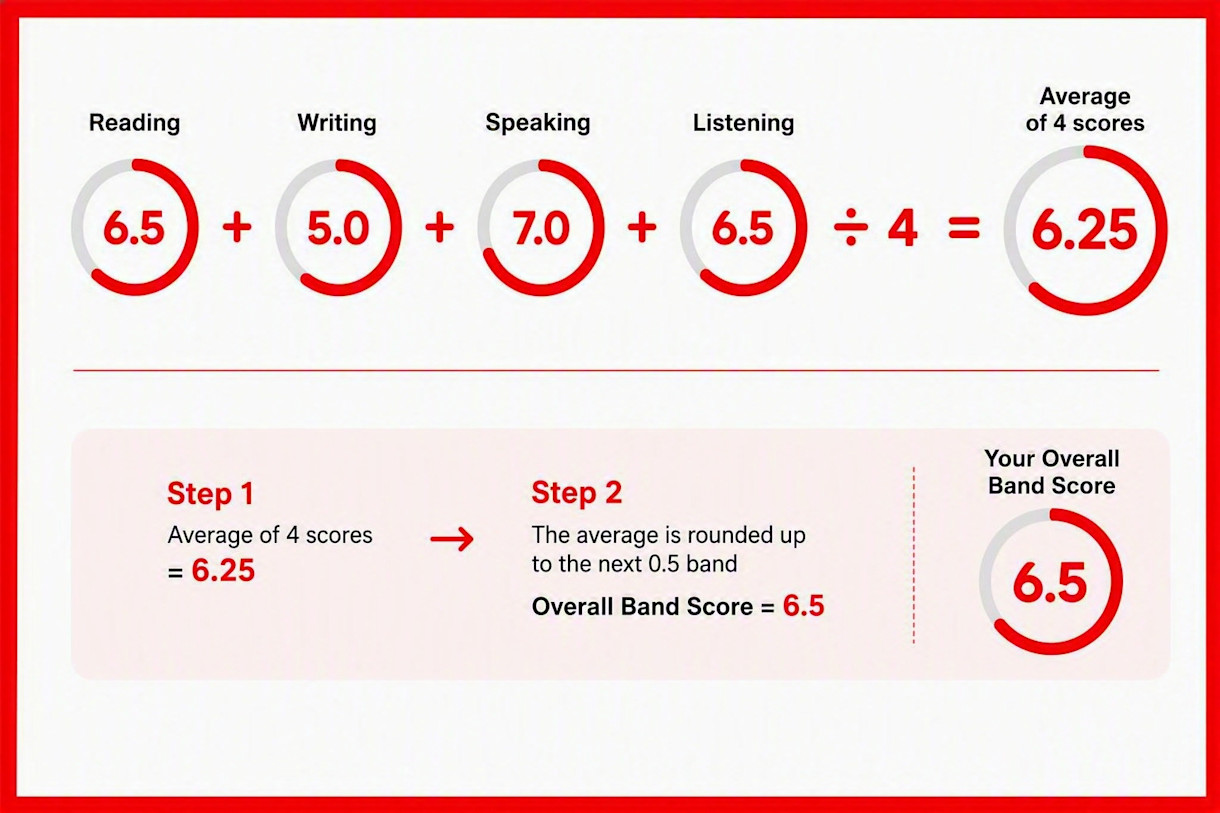
You’ll get an IELTS band score for each test section as well as an overall band score, which is the average of the four section band scores rounded to the nearest half band.
For example, if you get a 6.5 in Reading, 5 in Writing, 7 in Speaking, and 6.5 in Listening, the average of these 4 scores would be 6.25. This score would be rounded up to 6.5 for your overall band score.
While Reading and Listening tests scores are based on the number of correct answers out of 40, Writing and Speaking tests are marked by accredited IELTS examiners using global marking criteria that you can read in the IELTS band descriptors.
Step 3: Check how ready you are
We know that one of the biggest questions you have when you take IELTS is, will I succeed? That’s why we recommend checking where you are now so you can book a test date and create a study plan that will help you achieve your target score.
You can check how ready you are for IELTS by taking our free English self-assessment tool.
Identify your strengths and weaknesses
The English self-assessment tool is a short practice test designed to assess your Reading and Listening skills. It takes around 20 minutes to complete, with an instant score, feedback on your answers and IELTS preparation recommendations. It’s a useful tool to identify areas to focus on and build up your confidence before test day.
Step 4: Create a study plan
How long does it take to prepare for IELTS? This will depend on your current English level, target band score and how often you can study. Many test takers spend between 1-3 months preparing for IELTS.
A good IELTS study plan should help you understand the test, improve your English skills, learn test strategies and manage your time.
It should also cover all four IELTS skills: Listening, Reading, Writing, and Speaking, but allow extra time for you to focus on the areas you need to improve most.
Here’s what you can do to create your study plan:
Set your IELTS study goals.
Decide how much time you can study each day.
Block out daily study time in your calendar.
Find IELTS preparation resources to build test skills and strategies.
Use practice tasks and tests to track your progress.
Not sure how to find the study resources you need? We’ll show you how to start your IELTS preparation in the next step.
Step 5: Develop your IELTS skills
Next, it’s time to start studying for the IELTS test.
For a guided introduction to the IELTS test, try an IELTS Masterclass or our IELTS Prepare by IDP video podcast series.
Our top 3 IELTS preparation resources for first-time test takers
Join our free 90-minute webinar, led by an IELTS Expert. The session covers the test format, scoring, preparation tips, question strategies and common mistakes to avoid, with time for questions at the end. For times and dates, contact your local IELTS test centre or download the IELTS by IDP app.
Our IELTS video podcast covers everything you need to know about the test. During this 10-part series, you’ll learn about the IELTS test structure, how to prepare, what to expect on test day and more. Each episode is 20-30 minutes in length and includes an interview with a different IELTS Expert.
The Official IELTS Familiarisation Test
Experience a full online practice test that covers the Listening, Reading and Writing sections of the IELTS Academic test. This practice test introduces you to the test screens and question types, so you know what to expect on test day.
More IELTS preparation resources to improve your skills
Our IELTS preparation library makes it easy to find other resources you may need. You’ll find grammar articles, question-type tutorials, sample answers, pronunciation videos, practice activities and more.
It’s a great place to find IELTS preparation tips on a specific question type such as labelling a plan, map or diagram in the IELTS Listening test, or to develop a particular skill like writing clear and well-organised paragraphs.
Step 6: Challenge yourself with mock tests
Taking practice tests throughout your IELTS preparation can help you check your progress and see what you need to improve before you sit your test.
Our IELTS Preparation library offers a range of practice questions to help you feel ready for your test.
Step 7: Book your IELTS test
When you’re ready, visit the booking page. You’ll be asked to select your city, pick a date and time, complete and submit a short form and pay your test fees.
Step 8: Get ready for test day
Watch the video above to take a virtual tour of an IDP IELTS test centre and find out what happens on test day.
Before test day, try to get a good night's sleep and make sure you know how you’ll get to the test centre in advance.
Arrive early and bring your identification documents. After checking in at the test centre, you'll be able to lock up your personal belongings before entering the test room.
Learn more about what to expect on test day.
During the test
You won’t be allowed to talk to other test takers once you’ve entered the IELTS test room, so if you have a question, raise your hand and an invigilator will help you. Remember to manage your time carefully so you can complete every task.
Step 9: Get your results
Once you've finished the test, your results are typically available online within 1 to 5 days. Your test centre will also mail you a hard copy of your official Test Report Form (TRF).
You can share your IELTS results with organisations through the IELTS Results Service e-delivery system. If an organisation requires a paper Test Report Form (TRF) sent by post, you can contact your test centre to arrange delivery.
Before you go
Finally, if you still have questions about IELTS that weren’t covered in this guide, visit IELTS Community by IDP.
You’ll receive free access to trusted answers from IELTS experts. You can browse our extensive question bank to find guidance at every stage of your IELTS journey, from choosing the right test to using your results.
We’re here to help you make it to your new life and give you the tools and support you need to make it a success.