



What comes to mind when you hear the word grammar?
For many people, it brings back memories of long classroom drills, dry worksheets and endless rules.
However, improving your grammar for IELTS doesn’t have to feel like going back to school.
This time around, it’s far less about memorising rules and far more about strategy. It’s about building on what you already know, spotting the gaps that are holding you back and practising in ways that fit your learning style and your busy life. When you approach grammar this way, it becomes a practical tool rather than a painful chore.
With targeted practice and the right resources, boosting your grammar can help you lift your overall IELTS performance and achieve the band score you need to get on with your new life.
Why grammar matters for your IELTS band score
Grammar plays an important role in how clearly and accurately you communicate your ideas in English. As a result, examiners assess your Grammatical Range and Accuracy in both the IELTS Writing and Speaking tests.
Using different sentence structures and appropriate verb tenses help you express yourself more precisely, making it easier for examiners to understand and follow your message.
How IELTS examiners assess grammar
Grammatical Range and Accuracy accounts for 25% of your IELTS Writing and Speaking scores. Examiners look for two key things:
Grammatical Range: how well you can use a variety of structures.
Grammatical Accuracy: how consistently you can use these structures correctly.
Grammatical Range
To achieve a band 6 or higher, you need to show the examiner that you can use different sentence forms. Examiners look for both simple and complex sentences.
Simple sentences: contain one complete thought. They have one or more subjects and one or more verbs. Grammar books call these independent clauses.
Examples: Many animals are losing their habitats. My job and my family keep me busy.
Complex sentences: have one independent clause and at least one dependent clause. A dependent clause is a group of words that contain a subject and verb but does not make sense on its own. Instead, it relies on the independent clause to show a complete idea. The dependent clause adds more information to the sentence, but it cannot stand alone.
Examples:
Although recycling is important, it is not enough to solve the growing problem of plastic waste.
I prefer cooking at home because it’s cheaper and healthier.
Learn how to use complex sentences in the IELTS test.
To achieve a band 7 and above, you need to show that you can use a variety of complex structures, like the complex sentences above.
You can use complex structures in many situations, such as when you’re comparing or contrasting ideas or explaining a result or effect.
Grammatical Accuracy
Your goal in IELTS Writing and Speaking is to make your sentences as accurate as you can, but don’t worry, they don’t need to be perfect. What really matters is how many mistakes you make and how much they affect communication.
If you make a lot of errors and these mistakes make it difficult for the examiner to understand you, your score will likely be limited to Band 5. At this level, mistakes happen often, and they can interrupt meaning.
To reach band 7 or higher, you can still make a few mistakes, but they should not stop the examiner from understanding you.
For Band 8 and above, examiners look more closely at the type of mistakes you make. They want to see whether your errors are systematic or non‑systematic.
Systematic errors: these are repeated mistakes that show a clear problem in a particular area of grammar. For example, you might get subject-verb agreement wrong.
Non-systematic error: these are occasional slips. For instance, maybe you use the incorrect verb tense, but most of the time you get it right.
This difference is not important for band 7, but it is for band 8 or higher where most of your sentences should be error-free. The occasional mistakes you do make should be non-systematic.
Learn more about how your IELTS Writing test is marked. Watch our video on Grammatical Range and Accuracy.
Common grammar mistakes that affect band scores
So, what are some common grammar errors that you should watch out for in your IELTS Writing and Speaking tests?
Verb tenses
Common mistakes with verbs include using the incorrect tense for the time you’re describing or switching tenses mid-sentence.
Examples:
❌ I have lived in Vietnam when I was a child.
✔️ I lived in Vietnam when I was a child.
❌ People are using the internet since many years ago.
✔️ People have been using the internet for many years.
❌ Sales rose slightly in May and then is falling again in June.
✔️ Sales rose slightly in May and then fell again in June.
Learn more: Understanding Verb Tenses
Plural/singular/uncountable nouns
Do you know which words have irregular plural forms or can’t be counted in English?
Examples:
❌ I need some informations.
✔️ I need some information. (uncountable)
❌ I’m doing a research.
✔️ I’m doing some research. (uncountable)
❌ There are twenty-five childs in her class.
✔️ There are twenty-five children in her class. (irregular plural form)
Subject-verb agreement
Do your verb forms match the subject that comes before them?
When the subject is singular, the verb must also be singular. When the subject is plural, the verb must be plural.
IELTS Grammar Tip: Watch out for uncountable nouns and don’t forget to add an ‘s’ to the verb for third-person singular verbs in the present simple tense.
Examples:
❌ She live in Japan.
✔️ She lives in Japan.
❌ There’s many reasons to study English.
✔️ There are many reasons to study English.
❌ The amount of plastic waste are increasing every year.
✔️ The amount of plastic waste is increasing every year.
Articles
Do you know when to use “a” or “the”? Common mistakes here include using “the” when speaking about something in general, leaving out “the” when describing specific things or choosing the wrong article.
Examples:
❌ My apartment is in a old building.
✔️ My apartment is in an old building.
(Use “an” before vowel sounds.)
❌ The Artificial intelligence has changed the way we work.
✔️ Artificial intelligence has changed the way we work.
(Don’t use “the” when speaking about something in general.)
❌ Government should invest more in public transport.
✔️ The government should invest more in public transport.
(Use “the” for describing something specific or if there is only one.)
Prepositions
In, at, on or to? As with articles, it’s easy to confuse these small words by choosing the wrong one or adding them when you don’t need them.
Examples:
❌ The government should focus in improving healthcare.
✔️ The government should focus on improving healthcare.
❌ I arrived to the airport three hours early.
✔️ I arrived at the airport three hours early.
❌ This essay will discuss about the advantages of online learning.
✔️ This essay will discuss the advantages of online learning.
IELTS Grammar Tip: Download our free Dependent Prepositions Study Guide.
Sentence fragments
A sentence fragment means something is missing in a sentence. Common mistakes include forgetting subjects or verbs, or the sentence might be missing an entire clause.
❌ Although international travel is more affordable today, has also created environmental problems.
✔️ Although international travel is more affordable today, it has also created environmental problems.
❌ The number of tourists in 2020 much lower than in 2010.
✔️ The number of tourists in 2020 was much lower than in 2010.
❌ Because young people are spending more time online.
✔️ Many social problems have emerged because young people are spending more time online.
Overcomplicated sentences
The longer your sentences, the easier it is to make mistakes. Common errors can include adding unnecessary or incorrect linking devices or forgetting punctuation. This can make it more difficult for the examiner to follow your ideas.
❌ Although many people argue smartphones are useful, but some individuals believe they are harmful.
✔️ Although many people argue smartphones are useful, some individuals believe they are harmful.
Error: Double conjunction.
IELTS Grammar Tip: “Although” and “but” cannot be used together in a sentence, so make sure you only choose one of these conjunctions.
❌ The number of students studying abroad has increased rapidly in the last decade it is partly because universities are offering more exchange programs and also because students want international experience.
✔️ The number of students studying abroad has increased rapidly in the last decade. This is partly because universities are offering more exchange programs and partly because students want international experience.
Error: Run‑On Sentence (two independent clauses joined without punctuation).
IELTS Grammar Tip: Break longer sentences into shorter ones and check punctuation.
❌ Many teenagers are spending too much time on social media, as a result they feel more stressed, even though social media helps them relax which is good for their mental health.
✔️ Many teenagers spend too much time on social media, and as a result, they feel more stressed. Although social media can help some young people relax, excessive use often harms their mental health.
Error: Contradictory ideas placed in one long, unclear chain.
IELTS Grammar Tip: Read your ideas to ensure they make sense. Check that you’ve used the correct linking words and phrases.
Using grammar accurately across all four IELTS skills
Using grammar correctly doesn’t just affect your Writing and Speaking; it can also improve your scores in Listening and Reading.
For gap‑fill tasks, you need to choose answers that not only match what you hear or read but also fit grammatically into the sentence.
An example from the IELTS Academic Reading test
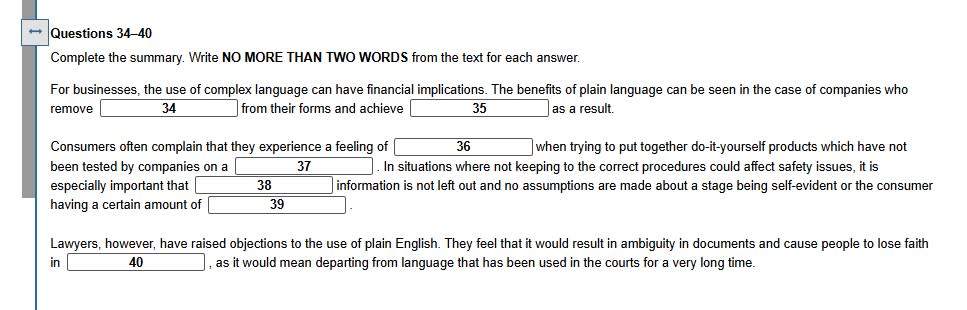
In the summary completion task above, you must understand the main ideas and choose the correct word type.
For instance, in Question 34, the verb remove needs to be followed by a noun (remove something from their forms). Because the instructions allow up to two words, the answer could also be an adjective + noun combination. Knowing which part of speech you’re looking for (noun, verb, adjective, etc.) helps you quickly rule out incorrect options and find the right answer with more confidence.
IELTS grammar strategies for high band scores
Improving your grammar for IELTS isn’t just about doing more exercises. What actually works is understanding the assessment criteria and practising the skills you need to develop the smart way.
Improve your range: Can you use both simple and complex sentences? To boost your band score, practise using a wider variety of complex structures accurately, for example, relative clauses, comparatives, and conditionals.
Choose appropriate grammar: While it’s important to show that you can use complex structures, don’t feel like you must fill your responses with long, complicated sentences. Sometimes, a simpler or more direct sentence can explain your ideas much more clearly. For example, passive voice is common in academic-style writing, but that doesn’t mean you should use it in every sentence. Test takers who achieve high band scores think about what kind of grammar helps them communicate their message in the clearest way.
Work on your systematic errors: What mistakes do you keep making? If you’re not sure, get feedback on practice Writing and Speaking tasks. Target these areas in your grammar practice.
Don’t forget punctuation: In IELTS Writing, the Grammatical Range and Accuracy marking criterion covers more than just verb tenses and sentence structure. Punctuation errors can also affect communication, so make sure it’s clear where your sentences begin and end.
Leave time to review: Aim to finish your Writing tasks a few minutes early so you can check your responses and correct any errors you notice.
IELTS grammar practice for busy learners
You might be wondering how you’re going to fit more grammar practice around work, study or family commitments?
The good news is that you don’t need long study sessions to make progress. Short, consistent practice is often far more effective. And being clear about your goals before you start can save you even more time.
Targeted grammar study: Spend your time only on the specific grammar areas you need to improve, rather than going through an entire workbook from start to finish.
Short daily grammar exercises: Even just five to ten minutes can help reinforce what you’ve learned and make it easier to remember grammar rules over time.
Apply new grammar in meaningful ways: Use simple speaking or writing prompts to practise grammar naturally in everyday situations. If you work or study in an English‑speaking environment, try weaving new language structures into an email to a colleague or into casual conversations with classmates.
This approach can help you make steady progress, even with a busy schedule.
How IDP supports your IELTS grammar improvement
As a co-owner of the IELTS test, IDP offers a range of trusted preparation resources to help you strengthen your grammar skills.
Grammar guides: Not sure when to use it’s vs its, or trying to make sense of phrasal verbs? Our grammar article series breaks down common challenges with clear explanations and practical examples.
Macquarie University online course: Prefer a more structured learning pathway? When you book your IELTS test with IDP, you’ll gain access to an online preparation course developed by Macquarie University. It includes more than 150 lessons covering grammar, vocabulary, and essential test strategies.
IELTS by IDP app: Stay motivated and learn on the go with our in‑app grammar quizzes and word games. Choose from three levels (Easy, Moderate, or Challenging) to suit your learning needs.
IELTS Practice tests: Apply what you’ve learned with our mock tests and sample questions. Practising under test‑like conditions helps reinforce your grammar knowledge and build confidence.