



Tourism is about so much more than just travelling to new places. It brings people, culture and languages together. Through travelling and hosting, we learn more about ourselves and each other.
It’s also an important income source for many countries, with a huge impact on infrastructure, employment and the environment.
As a result, it’s no surprise that this global topic is often included in the IELTS test.
To mark the United Nations’ World Tourism Day (27 September), this article focuses on how to discuss travel and tourism in your IELTS test. We’ll explore how this topic can appear in different parts of the test and how to build your tourism vocabulary. We’ll also give you the opportunity to practise an IELTS essay on tourism and look at a band 7 sample response to help you strengthen your own writing.
Tourism is a common IELTS topic: How it can appear in the test
Travel is one of many topics that might be covered in the IELTS test, so it’s important to be able to discuss both personal and global aspects of tourism.
Tourism in IELTS Academic Writing Task 1: Visuals
If you’re taking the IELTS Academic Writing test, you’ll be asked to describe a visual such as a graph or chart for Task 1. Data could be tourism-related, such as the number of international tourists visiting different countries over a particular time period. Or you might be asked to compare two maps, showing changes and new developments that have taken place over time.
Preparation tip: You’re not being tested on your knowledge of the topic. Focus on describing data and identifying trends rather than speculating on why they occur.
Tourism in IELTS General Training Writing Task 1: Letters
If you’re taking the IELTS General Training test, you’ll be asked to write a letter for Writing Task 1. Travel can appear as a topic in both formal and informal letters such as:
A letter of request, asking a travel company for information about tours
A letter of complaint, expressing dissatisfaction with tourism services
A letter to friend, recommending places to visit in your country
Preparation tip: Learn both formal and informal ways to ask for information, make suggestions and express dissatisfaction. Make sure you understand when each tone is appropriate.
Tourism in IELTS Writing Task 2: Essay topics
In both the IELTS Academic and IELTS General Training tests, you’ll be asked to write an essay for Writing Task 2. Travel-related questions often focus on how tourism connects to other topics such as technology, culture, the economy and the environment. You may be asked to discuss two different views or problems and solutions, or give your opinion on a topic.
We’ll take a closer look at a practice essay topic on tourism later in this article.
Tourism in IELTS Speaking Part 1: Personal Experiences
In Part 1 of the IELTS Speaking test, the examiner asks you questions about familiar topics such as your hometown, work, study and hobbies. Part 1 questions tend to focus on personal experiences, so if tourism is covered, you might be asked about,
Your holidays and travel experiences
What tourists can do in your hometown/country
What types of holidays you prefer
Whether you prefer travelling with others or alone
Future travel plans
Places you’d like to visit
Preparation tip: Listen to the verb tenses the examiner uses and make sure your answers match this. For example, if the examiner asks you about a past holiday, use past tenses such as the past simple when you’re responding.
Tourism in IELTS Speaking Part 2: Describing a Travel Experience
In IELTS Speaking Part 2 you’ll be given a card with a topic. You’ll have one minute to prepare. You’ll then need to talk about the topic for two minutes.
Tourism-related cue cards might ask you to describe:
A memorable holiday
A special place you visited
A journey you enjoyed
A popular tourist attraction or festival in your country
A place you would like to visit in the future
Preparation tip: Use discourse markers (e.g. first of all, next etc) to structure your talk and make sure you cover all the points on the card.
Tourism in IELTS Speaking Part 3: Discussing Global Tourism
In IELTS Speaking Part 3, you and the examiner will discuss issues related to the topic you talked about in Part 2. If you're asked about tourism, expect questions that focus on wider issues and concepts rather than just your personal experiences.
For example, you might be asked about:
advantages and disadvantages of tourism
impact of tourism
sustainable tourism
globalisation
the role of governments in tourism
how tourism has affected your country
how tourism has changed over the past decades
technology and travel
the future of tourism
Preparation tip: Extend your answers as much as you can. For instance, give reasons for an opinion or speculate about future changes.
Tourism in IELTS Reading and Listening
Tourism can also appear as a topic in the Reading and Listening sections of the IELTS test.
For example, in the IELTS Academic and General Training Listening tests, you may need to take notes while listening to someone calling a tourist information office to ask about hotels, tours or attractions. Or you might need label places on a map while someone gives a tour.
In the IELTS Academic Reading test, you’ll be given texts on topics that are of general interest to students at undergraduate or postgraduate level. If travel is covered, passages might explore different aspects of tourism such as history, challenges and impact.
The IELTS General Training Reading test includes everyday texts, so you may be asked to find important information in timetables, advertisements or notices, such as train times or holiday accommodation options.
Preparation Tip: Building a strong tourism vocabulary can improve performance across all four IELTS skills, not just Speaking and Writing, making it a valuable topic to study.
Building your IELTS tourism vocabulary
When building your tourism vocabulary, a great place to start is learning how to paraphrase. Paraphrasing is expressing the same idea in different ways.
In IELTS, this helps demonstrate your vocabulary range and overall English proficiency. Beyond the test, it's a valuable communication skill for university and workplaces that can help you summarise information and explain other people’s ideas in your own words.
Travel and tourism word families
One way you can paraphrase is by changing the form of a word.
Word family | Noun | Verb | Adjective | Adverb |
Travel | travel (uncountable) traveller/trip/journey (countable) | travel | travelling | - |
Tourism | tourism (uncountable) tourist/tour (countable) | tour | touristic (neutral/positive) touristy (negative) | - |
You may need to change the sentence structure if you do this.
Example:Tourism is one of Mexico's largest industries.
Paraphrase: Mexico attracts millions of tourists every year.
Watch out for these common mistakes:
❌ I went on a travel to Greece last summer. (travel is an uncountable noun)
✅ I travelled to Greece last summer.
✅I went on a trip to Greece last summer.
❌ I recommend their touristy excursions. (touristy means something is unattractive because there are too many tourists)
✅ I recommend their touristic/tourist excursions.
Tourism synonyms for IELTS
Another way to paraphrase is to learn synonyms for common words related to travel and tourism. Synonyms are words with similar meanings. Here are a few to get you started:
Tourist: traveller, sightseer, visitor, holidaymaker, vacationer
Travel: tourism, trip, journey, tour, excursion, holiday, vacation
Tourism: travel, sightseeing, travel/tourism industry, travel/tourism sector, visitor economy
International travel: overseas travel, foreign travel, travelling abroad
Domestic travel: local travel/tourism, domestic tourism, in-country travel, internal travel
Did you know? Americans typically use the word vacation while British English speakers use holiday. There are also spelling differences. In British English, words such as traveller,travelling and travelled are usually spelled with a double l, whereas American English uses a single l (traveler, traveling and traveled).
Common tourism collocations for IELTS
You can also paraphrase by learning common tourism and travel collocations. Collocations are two or more words that are naturally used together. For example, we say ‘take a trip’ not ‘make a travel’ and ‘tourist destination’ not ‘tourist place.’
Words that collocate with ‘tourist’
Adjective + tourist | Verb + tourist | Tourist + noun |
Foreign tourist, international tourist, domestic tourist | Attract tourists, draw tourists | Tourist attraction, tourist area, tourist destination, tourist trap, tourist resort, tourist hotspot, tourist information, tourist guide, tourist season |
Words that collocate with ‘travel’
Adjective + travel | Travel + noun | Travel + adverb |
International travel, domestic travel, air travel, train travel, business travel, first-class travel, overseas travel, cheap travel, off-season travel | Travel agency, travel industry, travel arrangements, travel plans, travel brochure, travel expenses, travel itinerary, travel insurance, travel diary | Travel regularly, travel widely, travel fast, travel slowly, travel independently, travel together, travel abroad |
Other travel and tourism collocations
Collocation | Word form | Meaning | Example sentence |
Go on/ have/take a holiday | Verb + noun | To spend time away from work or study for leisure and relaxation. | I’m going on holiday next week. |
Go on/take/make a trip | Verb + noun | To travel from one place to another for a specific purpose. | We made a trip to the coast during the university break. |
Book a hotel/flight/tour | Verb + noun | To reserve accommodation, transport, or an organised activity in advance. | We booked a motorbike tour. |
Make a reservation | Verb + noun | To arrange and secure a place, seat, or service in advance. | I’d like to make a reservation for 7pm. |
Go sightseeing | Verb + noun | To visit interesting places and attractions as a tourist | London tourists often go sightseeing in Greenwich. |
Plan an itinerary | Verb + noun | To organise a schedule of travel activities and destinations. | Before our trip, we planned our itinerary for the entire week. |
Miss a connection | Verb + noun | To fail to catch a connecting flight, train, or bus. | Kim’s first flight was delayed, so she missed her connection to Toronto. |
Peak season | Adjective + noun | The busiest time of year for tourism. | Hotel prices are usually higher during the peak season. |
Package holiday | Adjective + noun | A holiday that includes transport, accommodation and sometimes activities for one price. | We prefer package holidays because they organise everything for us. |
Budget accommodation | Adjective + noun | Low-cost places to stay, such as hostels or cheap hotels. | Many students choose budget accommodation to save money while travelling. |
Self-catering accommodation | Adjective + noun | Accommodation with cooking facilities where guests prepare their own meals. | We usually stay in self-catering accommodation like campsites. |
Luxury resort | Adjective + noun | A high-end holiday destination offering premium facilities and services. | The Maldives is famous for its luxury resorts and private islands. |
Historical site | Adjective + noun | A place of historical importance or significance | Angkor Wat is Cambodia’s most visited historical site. |
Natural wonder | Adjective + noun | A remarkable natural feature known for its beauty or uniqueness. | The Great Barrier Reef is considered a natural wonder. |
Preserve cultural heritage | Verb + noun | To protect and maintain traditions, customs, and historical sites. | Governments should preserve cultural heritage for future generations. |
Sustainable tourism | Adjective + noun | Tourism that minimises negative environmental and societal impact while benefiting local communities. | Many travellers are choosing sustainable tourism options like eco-friendly hotels. |
Mass tourism | Adjective + noun | Large numbers of tourists visiting a destination, often creating pressure on local resources | Mass tourism is causing overcrowding in Venice. |
Depend on tourism | Verb + noun | To rely on tourism as an important source of income or employment | Many island nations depend on tourism for economic growth. |
Generate revenue | Verb + noun | To produce income for a business, community or government. | Tourism generates significant revenue for the local economy. |
Boost the economy | Verb + noun | To increase economic activity and growth | International visitors are boosting the economy through their spending. |
Create jobs | Verb + noun | To provide employment opportunities | The tourism industry creates jobs in hospitality, transport and retail. |
Building a Tourism Vocabulary Mind Map
If you’re a visual learner, try creating a mind map to help you remember collocations and vocabulary related to common IELTS topics like travel and tourism.
A mind map helps you organise topic-related language into different categories. Your mind map might include shapes, arrows, lists and different colours. You may also wish to personalise it by adding examples of your own travel experiences. The key is to organise new language in a way that makes sense to you.
A good way to start a mind map is to think about common questions you might be asked on a topic and then use the mind map to answer them. Here’s an example for travel and tourism:
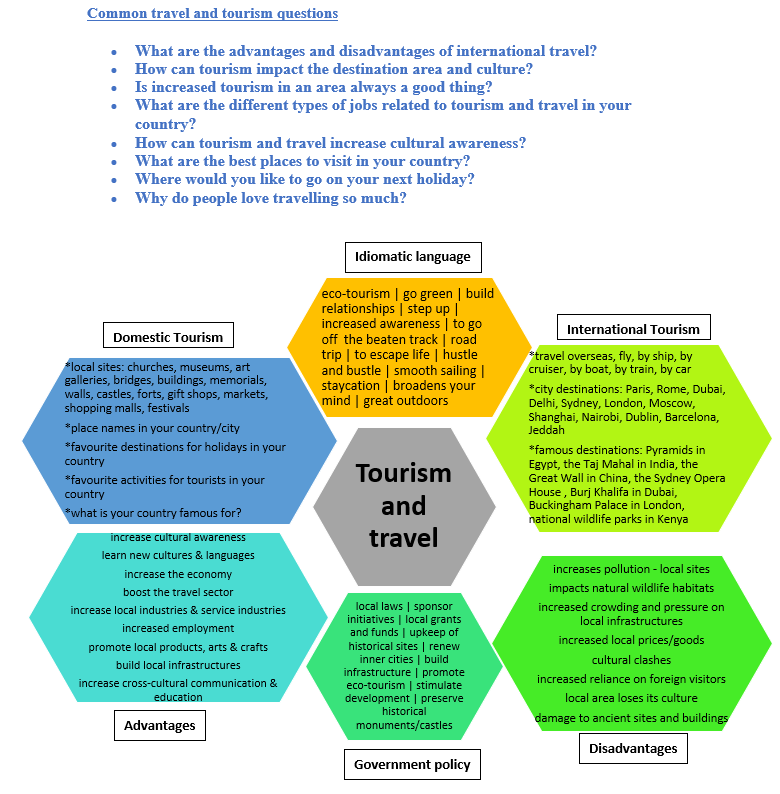
Source: Vocabulary to help prepare for common IELTS topics
Using your tourism vocabulary for IELTS Preparation
Now it’s time to use your new vocabulary in an IELTS Writing Task 2 topic. This question comes from the IELTS Academic test. Follow the steps below to write an IELTS essay on tourism.
IELTS essay practice: International tourism
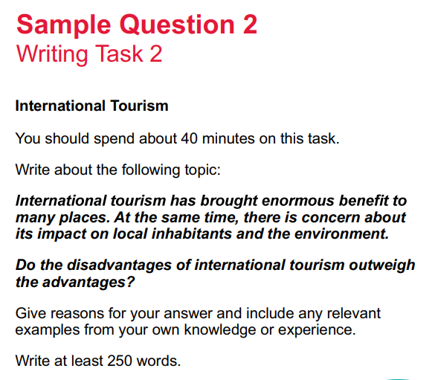
Step 1: Underline key words in the question prompt e.g. international tourism, benefit, places, concern, impact, local inhabitants, environment, disadvantages, advantages. What are some synonyms for these words that you could use in your essay to avoid repetition?
Step 2: Brainstorm the advantages and disadvantages of international tourism. Decide on your position and create a quick essay plan. Use bullet points only. You won't be marked on your plan, so focus on organising your ideas. Aim to spend no more than 5-10 minutes on Steps 1 and 2.
Step 3: Write your essay. Include an introduction, two or three body paragraphs and a conclusion. Each body paragraph should focus on an advantage or disadvantage. Don’t forget to develop your ideas through explanations and examples.
Step 4: Leave time at the end to proofread and edit your essay. As well as reviewing spelling and grammar, check your writing for other issues like overused words or paragraphs or unconnected ideas.
Step 5: Compare your response against the IELTS band descriptors, looking at the criteria for the score you’re aiming for. If you need some help understanding how your writing is marked, watch our short video series.
Step 6: Finally, compare your practice essay with a real IELTS essay that scored a band 7. This sample also includes examiner comments so you can see why it was awarded a band 7.
Step 7: Make a list of the areas you want to improve. You can use the resources in our IELTS Prepare Hub to work on these points before you try another practice essay.
Conclusion
As we’ve seen throughout this article, tourism overlaps with many other IELTS topics and can be discussed from a wide range of perspectives. It gives you plenty of opportunities demonstrate your English proficiency skills and use a broad range of vocabulary.
This World Tourism Day, make tourism vocabulary part of your study plan. Expanding your vocabulary can help you discuss this global topic in your IELTS test and beyond. Whether you’re planning a trip, hosting visitors or working in the tourism industry, a strong vocabulary can help you communicate more confidently in real-life situations.