



Form, table or note completion are common question types in the IELTS Listening test. These tasks check how well you can understand and record key details while listening.
You’ll often hear information such as names, dates, numbers or short pieces of factual detail. Your job is to write them down accurately.
In this guide, we’ll share five practical tips to help you approach these IELTS Listening test questions with confidence and boost your overall listening score.
What are IELTS Listening form, table and note completion tasks?
This type of question targets the important points that listeners would most likely write down. Some tasks focus on everyday, social situations such as listening to a conversation and filling in a membership form for a gym. Other recordings focus on educational training situations and could involve a task like taking notes in a lecture. They can appear in the following formats:
a table: used to summarise information that falls into separate groups, e.g., place/time/price.
a form: often used for facts, e.g., name, address, phone number.
a set of notes: used to summarise information and show how different points are connected to each other.
Sometimes this question type can take the form of a flowchart that outlines the steps in a process, usually with arrows showing the order.
Read more about IELTS Listening flow-chart completion questions.
For form, table and note completion tasks, you might need to:
Fill in gaps with exact words from the recording, following the word limit in the instructions,
or
Choose answers from a list and write the correct letter on the answer sheet (or drag and drop it into the gap if you’re taking the computer-based test).
Many test takers find these questions straightforward once they know what to listen for and how to avoid common mistakes. Let’s look at how you can tackle these question types.
Tip 1: Predict the type of missing information
Before listening, look at the gaps in the form, table or notes and consider the following question: Is this a name, date, number, place, noun, adjective or something else? This will help you listen more effectively.
Quick task: Look at the gap in the IELTS Listening note completion below. What kind of information is missing?
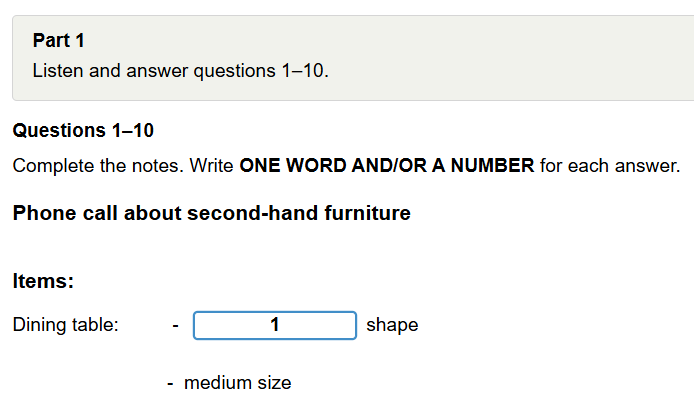
Source: The Official IELTS Familiarisation test | IDP IELTS

Answer:
The missing word is an adjective, used to describe a shape, e.g., round, triangular.
Tip 2: Review English letters
IELTS Listening form completion tasks often ask you to write down words that are spelled out, such as the names of people or places.
Make sure you are familiar with the names of the letters in English and any sounds which often cause you confusion.
Take care with letters that sound similar such as ‘m’ and ‘n’ and ‘t’ and ‘d’ or letters like ‘z’ that have a different pronunciation in British and American English.
Quick task:
Click here to listen to the first part of a telephone conversation between a customer and an agent at a company which ships large boxes overseas. Answer questions 1 and 2 to practise listening to letters in English.
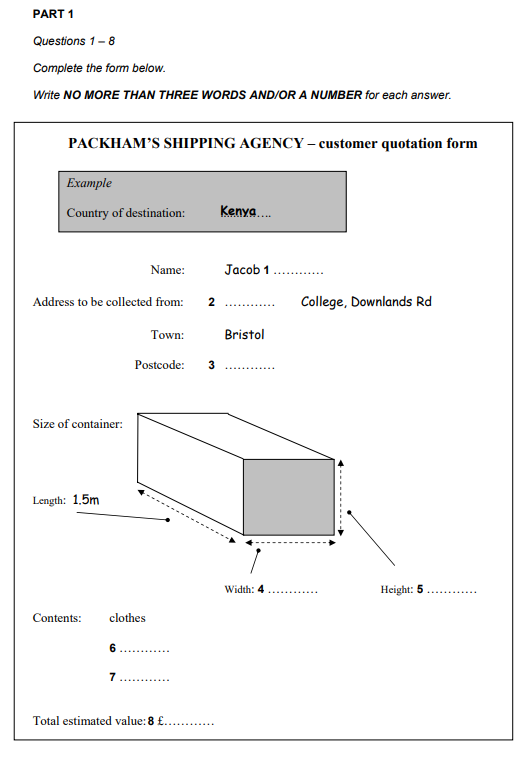
Source: Free IELTS Listening – practice sample questions | IDP IELTS
Watch our video podcast episode on IELTS Listening.
Answers to quick task:
Mkere
Westall
Tip 3: Review English numbers
Another way you can prepare for table, form and note-completion tasks is to review different ways of saying numbers in English. Here are some different types of numbers you might hear in the IELTS Listening test:
Phone numbers, years, dates, times, money, measurements, decimals fractions and ordinal numbers*
*Sequence numbers like 1st, 2nd, 3rd etc.
Take care with numbers that sound similar like “thirteen” vs. “thirty.”
Be aware of different ways of saying the same number. For example, there are several ways you can describe the time in English.
7:45pm = seven forty-five, quarter to eight and 19:45.
Quick task: What are some different ways to say this price: $5.50?

Answers: five dollars fifty, five dollars and fifty cents, five fifty.
Learn more: Boost Your IELTS Listening Score by Fixing Common Punctuation and Number Mistakes
Tip 4: Watch out for distractors
In the IELTS Listening test, you’ll often hear a piece of information that sounds like it could be the correct answer, but it is not.
These distractors check whether you are listening carefully to the whole message, not just catching keywords.
For example, imagine you are listening to a talk at a university orientation, and you need to note down a lecturer’s office hours:
Question: Dr. Evans’ office hours this week: _________
Recording: "Dr. Evans usually holds office hours on Thursday afternoons. However, this week she’ll be available on Friday morning instead."
Here, ‘Thursday afternoons’ is a distractor and ‘Friday morning’ is the correct answer.
Sometimes the speaker changes their mind while talking and self-corrects, like the example below:
Recording: “The price is $15—sorry, $50 per person”.
Tip: Always listen until the speaker finishes their sentence or idea before you answer the question.
Quick task: Look at question 19 in the IELTS Listening table completion task below.
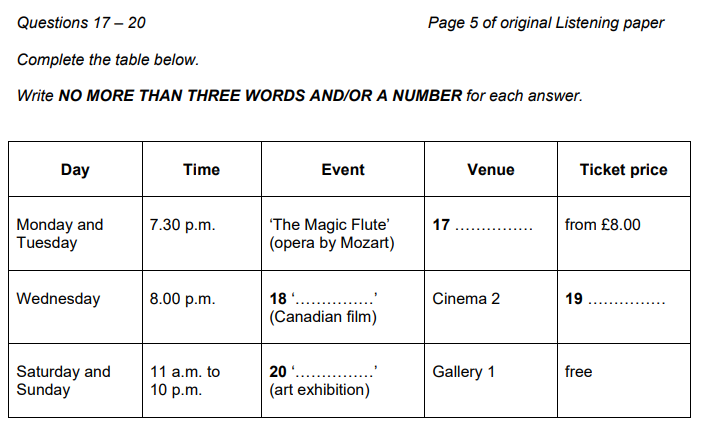
Source: Free IELTS Listening – practice sample questions | IDP IELTS
Now read an extract from the recording:
“It’s had fantastic reviews and tickets cost just $4.50, which is a reduction on the usual price of $5.50. So, it’s really good value, especially for such a great movie.”
What is the correct answer for Question 19?

Answer: $4.50.
Tip 5: Review your answers carefully
If you need to fill in gaps with words from the recording, check the word/number limit and make sure you have followed this. Writing extra words will make your answer wrong even if the content is correct. Check spelling carefully, especially names and places.
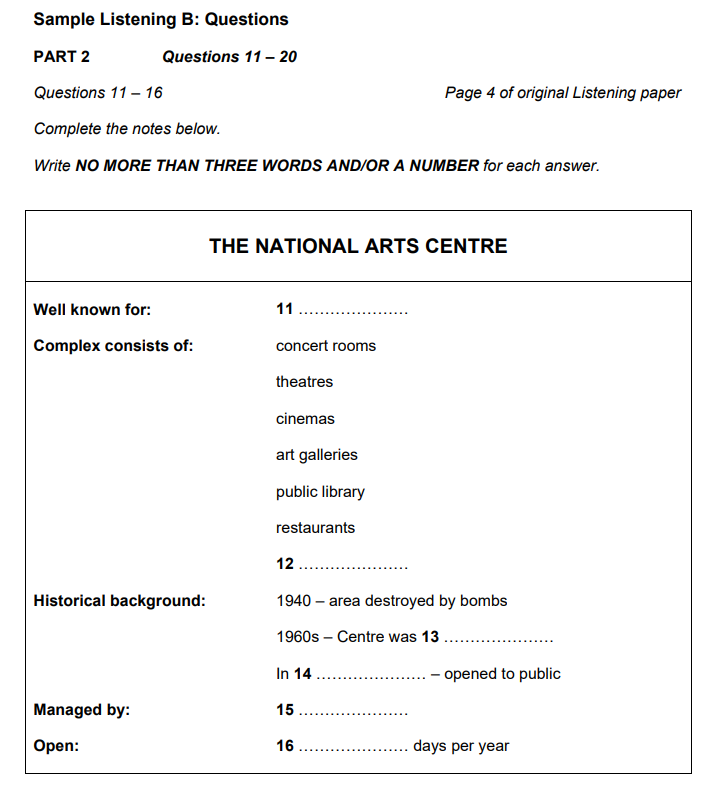
Quick task: What is the word limit for the IELTS Listening note completion task below?
Source: Free IELTS Listening – practice sample questions | IDP IELTS
Answer: No more than three words and/or a number.
IELTS Listening practice test questions
Try the practice questions below to apply the tips you’ve learnt in this article.
Every question you tackle not only builds you confidence for IELTS but also sharpens the listening skills you’ll use in real-life English situations long after your test.