


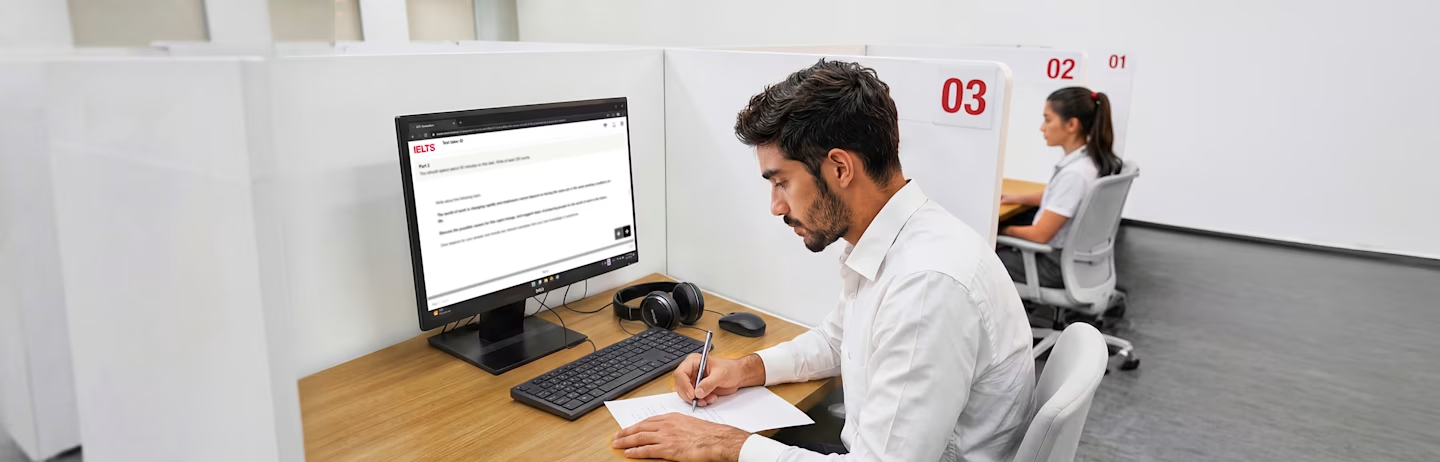
We’re committed to giving you the flexibility to take the IELTS test your way because we know that choosing the test format that suits you best can make a real difference to how you feel on test day.
With IELTS on computer (Writing on Paper), you can enjoy the benefits of computer-delivered testing with the familiar comfort of writing by hand.
Writing on Paper is available for both the IELTS Academic and IELTS General Training tests (excluding IELTS for UKVI) and is available in selected countries from 1 July 2026. In this article, we’ll break down how this new test option works and how to prepare with confidence to achieve your best possible result.
What is IELTS on computer (Writing on Paper)?
The IELTS on Computer (Writing on Paper) is a new test delivery option that allows you to take the IELTS test on a computer but complete the Writing section by hand.
If you choose this option, your Writing tasks will be shown on screen, but you will be given an IELTS Writing Answer Sheet and a pen to complete the tasks.
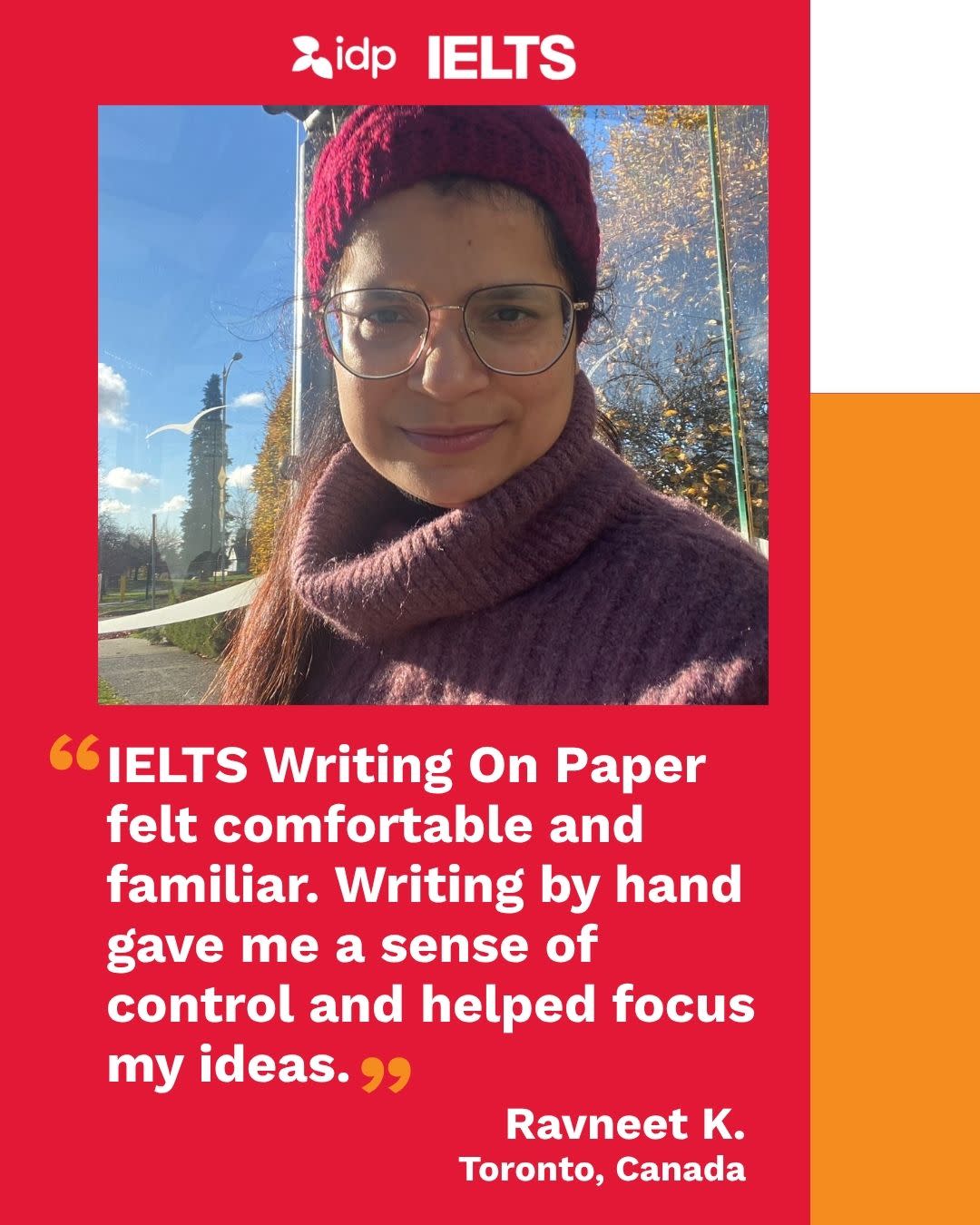
If writing by hand feels more natural than typing, our Writing on Paper option could help you feel more comfortable and perform at your best on test day.
What is the IELTS on computer (Writing on Paper) test format?
What the full test looks like
If you choose Writing on Paper, you won't need to learn a new test format. The tasks, timing and scoring remain the same. The only difference is that you write your answers by hand for the Writing section.
IELTS on computer | IELTS on computer (Writing on Paper) | Time allocation | Parts | |
Listening | On computer | On computer | 30 minutes | 4 |
Reading | On computer | On computer | 60 minutes | 3 |
Writing | Questions on computer. Typed responses. | Questions on computer. Handwritten responses. | 60 minutes | 2 |
Speaking | With an examiner | With an examiner | 11-14 minutes | 3 |
What the Writing test looks like for Writing on Paper
You’ll have 60 minutes to complete the Writing section of the IELTS test. During that time, you’ll need to complete two tasks. It’s recommended that you spend about 20 minutes on Task 1 and 40 minutes on Task 2.
IELTS Academic Writing
Task 1: Describe some visual information in your own words
You’ll have to summarise the information you see in a graph, chart, table, diagram or map.
Word limit: At least 150 words
Task 2: Write an essay
You’ll be given a point of view, argument or problem which you need to discuss in an essay format.
Word limit: At least 250 words
IELTS General Training
Task 1: Write a letter
You’ll be asked to respond to a situation by writing formal, informal or semi-formal letter. For example, you may need to ask for information, explain a situation, make a complaint or offer recommendations.
Word limit: At least 150 words
Task 2: Write an essay
You’ll be given a point of view, argument or problem which you need to discuss in an essay format.
Word limit: At least 250 words
What happens on test day when you do the Writing test on paper
As mentioned above, you’ll do the IELTS Listening and Reading sections on a computer in a test centre. When it’s time for you to complete the Writing section of your IELTS test, you’ll watch a short video, which gives instructions. When you’ve finished watching the video, you’ll be asked to put up your hand to request the paper answer sheets.
An invigilator will give you the paper answer sheets and a pen to handwrite your two task responses. The questions will be displayed on the computer screen throughout the Writing test. You can ask for extra paper if you need it. At the end of the test, an invigilator will collect your papers before you leave the test room.
Want to see what this looks like on test day? Watch our Writing on Paper test tutorial.
IELTS on computer (Writing on Paper) test tutorial (01:44)
How to prepare for IELTS on computer (Writing on Paper)
You can prepare for Writing on Paper the same way you would prepare for any other IELTS test. The test content is the same as the Writing test on computer. You'll also be assessed in the same way, by trained examiners who use the marking criteria that is set out in the IELTS Writing band descriptors.
Use the IELTS prepare hub
Find official IELTS IDP preparation materials all in one place in our IELTS Prepare Hub. We know that everyone learns differently, which is why we provide a wide range of free preparation materials for all four skills, including Writing.
Prefer to learn online? Try our videos, podcasts and IELTS computer-based practice tests. Print our practice tests and articles. More comfortable with paper? Download and print our practice tests and articles.
Experience the test format
Our computer-delivered practice tests can help you build confidence with timing and navigating the test screens before you sit your IELTS test.
See how writing questions are presented on screen with our Writing on Paper practice tests.
Experience the IELTS computer test format with our Listening and Reading familiarisation tests.
Want to prepare for Speaking too? Whether you choose to type your IELTS Writing test on computer or handwrite your responses, the IELTS Speaking test is always conducted face-to-face with an examiner. Watch our IELTS Speaking Test Video Series so you know what to expect on test day.
Practise handwriting your responses with our practice tests
Here’s how you can use our IELTS practice tests to get ready:
Access our IELTS on computer (Writing on Paper) practice tests on your computer or device.
Set a timer (20 minutes for Task 1 and 40 minutes for Task 2) to simulate real test conditions.
Handwrite your answers on paper.
Practise estimating your word count as you write to follow task requirements.
Review your writing and identify any areas for improvement. You can use the IELTS Writing band descriptors as a self-assessment checklist.
Watch our video series How your IELTS Writing test is marked for extra support.
Build a personalised study plan
Before you begin your IELTS preparation, it’s important to know what band score you’re aiming for, so that you understand what areas you need to work on. IELTS score requirements are set by recognising organisations, not IELTS, so make sure you check what score you need with the institution you’re applying to.
Once you know your desired score, follow these steps to create a study plan that balances all four IELTS skills and focuses on the areas where you need the most improvement.
1. Review the IELTS Writing and Speaking band descriptors to understand what you need to demonstrate to achieve your target score.
2. Set aside regular study time by deciding how much time you can dedicate each day and blocking it out in your calendar.
3. Choose a realistic test date that gives you enough time to prepare. You can book your IELTS test here.
4. Take a full practice test to identify your strengths and weaknesses.
5. Focus on your weak areas using targeted IELTS preparation materials and practice activities.
6. Track your progress by taking extra practice tests regularly and adjusting your study plan as needed.
Why take Writing on Paper?
The IELTS on computer (Writing on Paper) test option combines the familiar experience of handwriting with many of the advantages of a computer-delivered test.
Choose the format that suits you: Select the test delivery option that helps you perform at your best.
Fast results: Receive your scores within 1–5 days.
Benefit from the same globally recognised IELTS standards: The same scoring standards, fairness and test content are used across all IELTS test formats.
IELTS One Skill Retake: If you don’t achieve your desired score, you may be eligible to retake one section of the test instead of the whole test.
Conclusion: choose the format that works for you
The IELTS on computer with Writing on Paper gives you more flexibility without changing what matters.
If handwriting feels more natural to you, this option allows you to combine the familiarity of writing on paper with the convenience and benefits of an IELTS computer-based test.
By choosing the format that suits you best, you'll be in the best position to demonstrate your English proficiency and take the next step towards your study, work or migration goals.
Visit the IELTS Prepare Hub today and start building your personalised preparation plan.